Showing posts with label Samuel Gebru. Show all posts

Sunday, July 29, 2012

Bypassing Politics? A Meeting with Ethiopia’s President


Mr. Samuel M. Gebru, CEO of the Ethiopian Global
Initiative and H.E. Girma Woldegiorgis, President of the
Federal Democratic Republic of Ethiopia. (Photo: Grand Palace)
Samuel M. Gebru (@SMGebru)
Addis Ababa, Ethiopia
July 29, 2012

It was an honor to be invited to the Grand Palace on Friday, July 20 to meet with the President of Ethiopia.

Girma Woldegiorgis, born in 1925, is currently 88-years-old and despite his age and health issues, his passion and service for Ethiopia is as young as my college-aged heart.

When I was told that I had an opportunity to meet with Ethiopia’s Head of State, I readily took the opportunity. While most discount the President of Ethiopia as a mere figurehead resembling Britain’s Queen Elizabeth II, I would argue that—just like the Queen—the President is what should hold the national fabric together as head of the Ethiopian state.

In 2010, I mistakenly argued that the government should do away with the Presidency because I thought it had no clear purpose. I have come to learn that it is the President who should inspire a new generation of public servants through his/her own merits. And who better than Girma Woldegiorgis for this role?

Sure, he has had his fair share of health issues and at one point was rumored to have died (although I can assure you that he’s alive and kicking!), Girma Woldegiorgis has the resume fit for the Ethiopian Presidency. Beyond his ability to speak seven languages, of which three are Ethiopian (Oromiffia, Amharic and Tigrinya), the President has been a lifetime public servant since his youth.

As I walked into the Grand Palace, built for Ethiopia’s last monarch, I was stunned by the magnificent Judeo-Christian motifs. From the rugs to the ceilings to the President’s desk, formerly the Emperor’s, the Grand Palace was a magnificent display of the ancient ties Ethiopia has to Christianity, Judaism and Israel.

Already briefed on me, the President expressed happiness to receive someone my age. I told him that it was hard for many like me to be taken seriously because of our age and that one needs old age and a title before receiving respect in Ethiopian society. He interrupted me and disagreed. He reminded me that he was 36 when he became Speaker of the Chamber of Deputies of Ethiopia’s Imperial Parliament in 1961 and that he was my age when he was called to national service in the Imperial Air Force, earning the rank of Lieutenant. 

In our meeting, I briefed President Girma on the Ethiopian Global Initiative’s vision for Ethiopia. He was very happy to learn that the organization’s core is built of students and professionals ranging from 18 to 35-years-old. I informed him how the Initiative aims to increase its presence in Ethiopia and undertake more programs and projects in healthcare, education, civic engagement and economic development. 
President Girma Woldegiorgis shows CEO Samuel Gebru
his Lem Ethiopia membership card. (Photo: Grand Palace)
President Girma is a noted environmentalist. As Speaker of Parliament, he designed the first environmental legislation in Ethiopia—perhaps one of the first in Africa. In March 1992, he founded Lem Ethiopia (The Environment and Development Society of Ethiopia), Ethiopia’s premiere civil society organization responsible for the protection of the environment. 

What impresses me the most about President Girma is his ability to bypass Ethiopia’s unpredictable political system and work with all governments. His transcendence of the Governments of Haile Selassie, Mengistu Hailemariam and Meles Zenawi is truly remarkable—and that he has earned everyone’s respect in the process. 

At the end, I asked President Girma what was the best advice he could give me. He said, “Continue what you are doing in meeting people from all sectors and backgrounds and learn more from them. It is only then can you become an effective public servant.”

I look forward to many more encounters with the President and wish him and the First Lady my warmest regards.

Samuel M. Gebru is 20-years-old and the Chief Executive Officer of the Ethiopian Global Initiative.

Friday, July 20, 2012

Celebrating African Innovation in Washington, D.C.


By: Emily Weinstein (@emyli_rose)
From L to R: Evan Anderson, Senior Associate to the President,
Samuel Gebru, CEO, Emily Weinstein, Project Manager. Credit:
Marie Claire Andrea.
July 20, 2012


The past weekend was productive and gratifying for the Ethiopian Global Initiative (EGI). Following the success of our traditional Ethiopian coffee ceremony at the Harvard Yard Starbucks in Cambridge, MA, EGI was honored to host a private reception at former Ambassador to Ethiopia The Honorable David Shinn's residence in Washington, DC. This was a truly great event, and I was thrilled as always to see my friends and EGI colleagues Samuel Gebru and Evan Anderson, President and Senior Associate to the President. I was honored to meet and mingle with prominent American government employees, two generations of Ethiopian ambassadors, as well as representatives from the Ethiopian Crown Council. I recall current Ambassador of Ethiopia Ato Tesfaye Yilma noting "EGI is a pioneer project," aligning our work to the theme of the weekend, which was to celebrate the pioneers of innovative business in Ethiopia. In a later discussion with Evan, I discovered we both shared a sense of pride at the Ambassador's supportive sentiments, as well as Samuel's description of EGI's projects which had inspired them.

Ato Thomas Debass, Director for Global Partnerships at the Department of State, also made an appearance with his wife Gelila Teshome, Senior Contracting Officer at the Executive Office of the President. The two were glad to share stories of their family, and I was eager to listen as they described the joys of raising their children in America, while striving to maintain a strong Ethiopian influence in their lifestyle. Thomas was honored as a keynote speaker the following evening at the 2012 Pioneer Ethiopian Diaspora Business Person of the Year Awards Dinner, where I and Dr. Lemma W. Senbet (who was sitting next to me, I caught him scribbling this quote onto the back of a business card just as I tweeted it!) made note of this profound highlight from his speech: "Africa cannot just be a destination for innovation, but also a source of innovation."

Honored at the 2012 Awards Dinner were Ato Tadiwos G. Belete and Ato Zemedeneh Negatu. The two men were awarded for their contributions to the growing economy of Ethiopia; these ambitious men took major financial risks because they believed Ethiopia was worth their investment. Tadiwos, CEO and founder of Boston Partners PLC has opened many resorts and day spas throughout Ethiopia, providing jobs for locals and attracting tourists. Zemedeneh is an industrious promoter of investment into Africa, as well as an active participant in initiatives showcasing Africa as an attractive investment destination. Both men were accompanied by an entourage of family, including Zemedeneh's young son Michael, who was more than happy to accept his father's award and participate in an EBS interview! In my opinion, young Michael's presence was a fervent reminder of the importance of youth in development, and I couldn't agree more with the notion illuminated by his father:  it is our responsibility to set a stable groundwork for the next generation.

Earlier in the day, both Tadiwos and Zemedeneh were featured panelists at the Ethiopian American 7th Annual Diaspora Business Forum, speaking of their success and the many reasons to invest in the rapidly growing yet largely untapped economy of Ethiopia. Beside them, other panelists included Dr. Lemma W. Senbet, The William E. Mayer Chair Professor of Finance and Director of the Center for Financial Policy at the University of Maryland – among a much longer list of credentials – and Matthew Davis, founder and CEO of Renew, an innovative investment company that "works with development organizations, development finance institutions, NGOs, governments and private investors to facilitate investments into promising businesses in developing countries." Conference attendees ranged from the areas of business, social science, academia, arts and entertainment. I was especially taken by the panel on tourism featuring archaeologist and anthropologist Dr. Yohannes Zeleke, President of the African Travel Association, and photographer and Ethiopian at heart Matt Andrea. An anthropology and photography major myself, I was captivated by the beautiful photographs of Ethiopian people, culture and the country's fascinating landscape. The information in this panel was presented with such passion, it solidified my desire to study abroad in Ethiopia; after all, where better to study anthropology than the birthplace of humanity and religion?

Following a day full of networking and inspiring presentations, Samuel and I joined Marie Claire Andrea and a few friends to relax with some traditional and modern Habesha dancing at a local Ethiopian restaurant. Overall, a fantastic weekend to be a staff member/supporter of EGI!

Congratulations to Ato Tadiwos and Ato Zemedeneh, proof that hard work, determination and faith do not go unrewarded. Special thanks to Ato Yohannes Assefa, who exerted much time and effort organizing the 7th Annual Diaspora Business Forum, as well as Dr. Liesl Riddle of George Washington University, gracious host of the conference.

For more information regarding the mission and projects of the Ethiopian Global Initiative, visit our website. 

Emily Weinstein is the Event Manager for Ethiopian Global Initiative. She is also double majoring in Anthropology and Photography and minoring in International Humanitarian Affairs at Fordham University.

Friday, May 25, 2012

Africa’s Brain Drain: Hopeless to Hopeful

By: Samuel M. Gebru (@SMGebru)
May 25, 2012

This article is an abbreviated version of a keynote address the author delivered at the Minnesota State University, Moorhead’s African Night on February 25, 2012.

“What can I bring to Africa?” “How can I help Africa?” These are frequently asked questions by people who are concerned about the political, economic and social development of Africa. Once dubbed the “hopeless continent” by The Economist, ten years later, The Economist is now correcting itself calling Africa the “hopeful continent.”

All around the world, people are awakening their curiosity to learn more about Africa. Often mistaken for a country, the African continent is home to a rich, diverse and driven people. In this article, I will first examine the causes and consequences of a global phenomenon that has deeply affected Africa known as the “brain drain.” Secondly, I will discuss the importance of the “brain gain” as a reversal to the negative impacts of Africa’s brain drain. Thirdly, I will share why the new concept of “brain circulation” is Africa’s latest weapon for success. Lastly, I will attempt to answer my initial question: “What can I bring to Africa?”

The brain drain is a global phenomenon where large amounts of the highly skilled and talented population of a country leave and migrate to another country for better opportunities. The brain drain is a significant problem affecting many developing countries.

Since the 1960s, Africa has experienced at great numbers the massive exodus of its skilled and talented workforce to other parts of the world. The brain drain occurs in three settings: internally, regionally and globally. On the global level, Africa’s brain drain occurs in two major settings. First is where individuals complete their education in Africa and migrate overseas for various political, economic and social reasons. Second is where African students who study abroad stay abroad after graduation and permanently settle into their new lifestyles. 

In both settings, Africa looses because its skilled population is leaving. In my native Ethiopia, the United Nations Development Programme estimates that between 1980 and 1991 Ethiopia lost over 75% of its skilled workforce. Imagine in just about one decade loosing the overwhelming majority of your country’s talented scientists, engineers, physicians, entrepreneurs, educators and attorneys. Indeed, this is a loss for the continent.

Arguably, the main causes of Africa’s brain drain include economic inequality between Africa and the rest of the world; political instability that threatens the safety and freedom of a country’s skilled workforce; and the colonial legacy and postcolonial mentality of Africa.

Economic inequality between Africa and the rest of the world is perhaps the most obvious reason for Africa’s brain drain. In the internal setting, a brain drain occurs when skilled people move from one part to another, more developed and urban part of a country. Similarly, at the global setting, a brain drain occurs when skilled people move from Africa to more developed parts of the world, such as North America, Western Europe and now Southeast Asia. These people, escaping the poverty and lack of perceived or real opportunities in Africa, find life in their new settings. Because Africa is comparatively underdeveloped and less industrialized, it looses.

Political instability is another obvious reason for Africa’s brain drain. Africa has seen its fair share of political strife, civil wars, religious conflict, anarchy and blatant disregard for human rights and the rule of law. These series of political factors are intolerable to all Africans, but in particular to those that make up the skilled and talented workforce. Bloody wars in countries like Sudan, Liberia, Ethiopia, Rwanda and Angola speed the brain drain by forcing out skilled workers and social activists. 

Lastly, the colonial legacy and postcolonial mentality of Africa strongly contribute to Africa’s brain drain. Because of the hundreds of years that Africa was subjected to a Eurocentric vision of the world, it has now become internalized in many societies that Africa has no returns for the skilled, and that it is indeed a hopeless continent. African professionals want to offer their services wherever they can receive the highest value in returns instead of embracing the Afrocentric viewpoint, which includes service to one’s community, a community-oriented method of living and a strong embracement of spiritual values. This is, of course, not to say that the Eurocentric vision of the world does not include these viewpoints, but I would argue that these viewpoints are central to African societies. Because of the internalization of the Eurocentric vision, many African professionals view no opportunities for growth in Africa and thus leave.

The consequences of the brain drain are many, but most importantly, Africa looses its human capital—its brain. Africa is deprived of the cutting-edge advancements that its professionals are making abroad for overseas companies and countries. Ultimately, the political, economic and social development of Africa is greatly stalled because the driving force is nowhere to be found.

The brain gain is the other side of the story: where large amounts of the highly skilled and talented population of a country leave and migrate to another country for better opportunities. Does this sound like the brain drain? Yes, because it is the brain drain, but only from the perspective of the one who is gaining and not draining.

The brain gain is most commonly witnessed in the United States. The United States has always been a destination for opportunity, a place where one has a real chance of claiming their piece of the American Dream.

In recent years, however, many skilled and talented Africans and non-Africans alike have started to migrate to the African continent. This phenomenon known as the brain gain reaps positive benefits for the continent because it is a reversal of the loss Africa has suffered. While the 1960s is typically known as the so-called start of the brain drain, Africa has suffered under the brain drain since the era of enslavement hundreds of years ago.

The brain gain offers new promise for Africa. Now being recognized as a continent of hope and opportunity, there is much to be said about Africa’s promise. Technological, political, economic and scientific advancements have placed Africa at a greater forefront than it ever was. Indeed, it is also known as “the last global frontier” in terms of its largely untapped reserve of natural resources. Unprecedented developments in information and communication technology (ICT) have completely overhauled the way Africa’s human capital operates and mobilizes. Investment in ICT allows for greater economic activity and development, attracting the attention of those living abroad that seek greater opportunities.

In the same manner that African professionals are leaving Africa and African students that study abroad are staying abroad, the process is now being reversed to where African students and professionals are returning to rebuild what was lost in their absence. The new generation of Africans is becoming aware of their modern history and of the triumphs and tragedies that Africa has faced in the past centuries. However, more important is that the new generation of Africans is awakening to the opportunities that lie ahead for Africa and is realizing that to make a positive and proactive difference, they must be the driving force behind those opportunities.

African governments are now realizing that not all students and professionals living abroad want to return. Some members of the African diaspora have settled comfortably for many years in their new adopted homelands, be it in the United States or elsewhere. Because of this, new incentives are being created and many governments in Africa have stared to open offices dealing directly with capturing the skill and talent of the diaspora. Correctly so, an increasing number of African countries consider their highly qualified nationals living abroad as an asset for national development.

The brain circulation is Africa’s latest weapon for success because one does not need to be in Africa to help rebuild Africa. Unlike the brain gain or the brain drain, the brain circulation is not a black-or-white phenomenon; it allows much room for creativity and innovation. The impact of the ICT sector is very evident in brain circulation. For example, Skype, Cisco Systems and other video and telephone conference services have allowed African and non-African professionals and students living abroad the opportunity to simultaneously connect with those who live in the continent. 

Advancements in tele-education have allowed professors from India the opportunity to teach courses in universities in countries like Ethiopia and South Africa without having to physically be there. Connected through video conferencing, these Indian professors are able to circulate their brain with students in Ethiopia and South Africa. 

Likewise, advancements in tele-medicine have allowed physicians in Kenya to diagnose patients with the medical help of physicians in the United States who are viewing these medical files through real time connection.

Virtual colleges and hospitals are just two examples of the advancements made through investing in the ICT sector in Africa. This allows mankind the opportunity for brain circulation without national or political barriers preventing us from communicating with one another. One does not need to live in Kenya, or be Kenyan to support the country’s development. Likewise, one does not need to live in Nigeria, Africa’s top oil producer, to help advise the government on new energy technologies and strategies. We can do this using our fingertips, laptops and mobile phones.

African governments are now realizing that the strength of its lost workforce does not need to return permanently to help rebuild the continent. National projects building roads and telecommunications systems are now being led and advised by the African diaspora. Without the effective involvement of the African diaspora, it is highly unlikely that any long-term results will be achieved. 

The forced removal of millions of Africans through enslavement is now being undone through the opportunities in brain circulation. The African diaspora with its resources and skills will be able to mobilize quickly and simply because we live in the information era. Otherwise known as the knowledge era, the information era thrives through the creation, manipulation, consumption and teaching of knowledge. This knowledge—this brain—is now a force that cannot be stalled at an airport because one cannot get a passport to enter Sudan or Zimbabwe. Rather, this knowledge is active through real time technology that allows us to be here and there, and consequently, everywhere.

Now that I have discussed the brain drain, brain gain and brain circulation, I would like to attempt to answer my initial question: “What can I bring to Africa?” Africa, once a byword for hopeless, poverty and famine, is moving forward through the strategic investment of knowledge. 

At the Ethiopian Global Initiative, the nonprofit I founded, our mission statement identifies two important things that we all can bring to Africa. First, our social capital: the value of networks, the value of who you know. Secondly, our intellectual capital: the value of human knowledge, the value of what you know. Social capital is important because it determines our ability to build and foster relationships and our ability to use those relationships for good. “Good” can include human rights, development, peace and cultural preservation. Intellectual capital, the value of human knowledge and resources, includes your skills, experiences and how competent you are. Intellectual capital has two important components, human capital—the individual—and structural capital—the society.

By harnessing our collective capital, by bringing it together in one brain trust, we bring to Africa one word: transformation. Because the intellectual diaspora can be tapped virtually wherever located, we as Africans and non-Africans alike, have the distinct opportunity of engaging Africa half a world away without ever leaving our bedrooms. 

The transformation we bring to Africa is manifested through political, economic and social development because our collective capital becomes Africa’s latest weapon for success. Understanding the importance of and utilizing our social and intellectual capital will allow greater influence in the political affairs, economic prosperity and social development of Africa. What Africa needs most is not aid, it is not even trade; it is the skilled and determined people to uproot the continent to realize its full potential. 

Your social and intellectual capital and the transformation we can collectively cause through it is what you can bring to Africa.

Just as it takes a village to raise a child, it takes a people to raise a continent.

Samuel M. Gebru is the President and Chairman of the Ethiopian Global Initiative.

Thursday, March 8, 2012

Salute Women by Improving Maternal Health

Click to enlarge.
By: Samuel M. Gebru (@SMGebru) and Zewdy Awalom (@Zewdy)
March 8, 2012

Today is International Women’s Day, an opportunity for us to celebrate the women worldwide making a positive impact to our families and communities. A United Nations-recognized political awareness holiday, International Women’s Day is aimed at giving attention to the political, economic and social struggles women in our world still face while also celebrating their vast achievements.

Dedicating a day for women reminds us of the challenges women endure and the strength they have. On the occasion of International Women’s Day 2012, we would like to focus on the urgent necessity of our world to focus on improving maternal health.

One third of all births take place at home without the assistance of skilled birth attendants. According to the World Health Organization (WHO), over 536,000 women die annually due to the lack of proper maternal healthcare. Over 3 million stillbirths and 3.7 million newborn deaths occur each year. Tragically, 99% of these maternal and child deaths occur in developing countries like Ethiopia and the vast majority of these deaths are preventable.

At the Millennium Summit in 2000, 192 United Nations member states, including Ethiopia, adopted the United Nations Millennium Declaration, pledging to “spare no effort to free our fellow men, women and children from the abject poverty and dehumanizing conditions of extreme poverty.” Improving maternal heath, the fifth goal of the Millennium Development Goals (MDGs), includes achieving universal access to reproductive health.

Quality maternal health services are fundamental to achieving successful births. In developing countries, where the urban-rural divide is greater, rural women have even less access to proper maternal health resulting in even more deaths.

These largely preventable tragedies must be addressed through improving the quality of and expanding the access to healthcare and education. According to the U.S. Agency for International Development (USAID), over 25,000 women die annually due to pregnancy-related complications in Ethiopia. More than 500,000 women suffer annually due to complications caused by pregnancy and childbirth.

The Ethiopian Global Initiative (EGI) is committed to improving maternal healthcare. EGI’s Midwives Scholarship Fund aims to fully fund the education of eight students at the Hamlin College of Midwives (HCM) in Ethiopia, a local private college accredited with the Ministries of Education and Health. HCM’s four-year programs grant students a Bachelor of Science in Midwifery. At the core of HCM’s work is the prevention of childbirth complications and deaths through education.

63% of illiterate young people globally, about 86,310,000 people, are women. Because many women are uninformed about their maternal health and legal rights these issues go unnoticed. By educating a new class of midwives in Ethiopia, HCM aims to improve the local healthcare workforce and keep Ethiopia’s human capital in country.

EGI aims to help women empower themselves. Educating women to become skilled midwives and deploying them to rural Ethiopia preventing childbirth complications and deaths is an enormous task that requires your generosity and support.

Join us and celebrate women daily. No woman should suffer during childbirth. Donate today and share our message with your friends.

Samuel M. Gebru is the Chairman and President of the Ethiopian Global Initiative. Zewdy Awalom is an up-and-coming R&B singer whose voice has been compared to that of Beyonce Knowles.

Saturday, December 31, 2011

Supporting the Women of Ethiopia

December 31, 2011

Dear friend,

I hope you are as excited as I am by what 2012 may bring for all of us. Wouldn't it be amazing for all women in Ethiopia to be guaranteed their right to safe childbirth?

This goal is already being undertaken at the Hamlin College of Midwives.

Our partners at Hamlin Fistula International have committed themselves to eliminate the number of women suffering from childbirth injuries by becoming the center for training, research, prevention and care of obstetric fistula. Maternal health is an important target that the United Nations set in the Millennium Development Goals for 2015.

Right now, you have an opportunity to be part of the world's vision for better maternal healthcare. We at EGI have committed to work with our partners at Hamlin Fistula International to fully fund the education of eight midwives at the Hamlin College of Midwives. By earning a Bachelor of Science in Midwifery, these midwives will return to rural Ethiopian communities to prevent childbirth injuries and increase awareness, therefore saving millions of lives.

Instead of sending these students abroad, they are being taught in Ethiopia at a recognized institution of higher learning. Our Midwives Scholarship Fund's goal is to raise $140,000. Can I count on you to support the women of Ethiopia?

Please make a meaningful contribution today and close 2011 by helping send a midwifery student to college.

Best wishes this holiday season!

Sincerely,

Samuel Gebru
President, Ethiopian Global Initiative

Friday, November 18, 2011

Samuel Gebru's 20th Birthday

Picture: Dawn Colquitt-Anderson
Dear friend,

The Ethiopian Global Initiative's founder, Samuel M. Gebru, is turning 20-years-old on Sunday, November 20! Isn't it amazing that he is just 19? 

You can help celebrate Samuel's 20th birthday by making a $20 donation to EGI's General Fund. Your donation, in honor of his birthday, helps us continue our work. We strive to be a positive force for development in Ethiopia but cannot do this without the support of people like you.

Please consider joining EGI in celebrating Samuel's 20th birthday by making a contribution of $20 today. We cherish your support and look forward to doing great work with you!

Sincerely,
The EGI Family

Monday, October 24, 2011

EGI Joins HSBA

Left to Right: EGI Vice President for Operations Leul Yohannes, EGI Director of Marketing Ryan Olivieri, HSBA
Executive Director Denise Jillson, EGI President Samuel M. Gebru, EGI Event Manager Emily Weinstein. (Photo: EGI)

The Ethiopian Global Initiative (EGI) formally joined the Harvard Square Business Association (HSBA) on Friday, October 21, 2011, in a meeting in Cambridge, MA, United States. Joining HSBA will bring EGI into a 101-year-old network of over 400 local and international organizations, universities, businesses and much more. EGI looks forward to developing relationships with members of HSBA and thanks HSBA's leadership for a warm welcome.

Thursday, October 6, 2011

The Magic of a Bitten Apple

A picture taken of my MacBook and me in 2010.
By: Samuel M. Gebru (@smgebru)
October 5, 2011

In the world of technology, Steven P. Jobs is a common name. Along with his colleague and competitor William H. Gates, III, the two are some of the few at the helm of technology as godlike figures. And with due credit, too.

That was, until today. This evening over dinner, a classmate told me that Jobs passed away. I told him that he was bluffing and that Jobs just had cancer and retired from his role as Apple Inc.’s CEO. As I said that, I received breaking news email alerts confirming true what I hoped was false. Inspiringly, my twitter and facebook feeds are filled with status updates on his passing as I write this.

I will forever know Steve Jobs, amongst other reasons, as the man who wore the same type of blue jeans and black turtle neck every day. His swag became a brand of its own. Steve Jobs was a businessman who envisioned and innovated. He engineered the digital empire we know today as a bitten apple.

An activist and inspirational leader of many sorts, Jobs’ message of living life for today and making meaning of it on all accounts continues to inspire me. One can only hope to be in the ranks of amazing humans that have made an impact in how we think, operate and envision. Although he will be missed, his profound impact is in the “i” forever.

Samuel M. Gebru is President and Chairman of the Ethiopian Global Initiative.

Friday, September 9, 2011

Ethiopian Airlines CEO to Deliver Keynote Address at 2011 BuildEthiopia Conference


FOR IMMEDIATE RELEASE

Addis Ababa, Ethiopia, September 9, 2011 – Ethiopian Global Initiative (EGI) President Samuel M. Gebru announced today that Chief Executive Officer Tewolde Gebremariam of Ethiopian Airlines is one of the keynote speakers at EGI’s 2011 BuildEthiopia Conference at Harvard University in Cambridge, MA, United States.

Sharing his excitement, Mr. Gebru stated that EGI “is happy to highlight the work of Ethiopian Airlines and of Mr. Tewolde Gebremariam, a career employee that built his way to the helm of Africa’s aviation success story.”

Saturday, July 30, 2011

EGI Statement on Horn of Africa Drought and Famine

Saturday, July 30, 2011
Somalis from southern Somalia carry their belongings
as they make their way to a new camp for internally
displaced people in Mogadishu Somalia, Saturday July
30, 2011. (AP / Farah Abdi Warsameh)
Cambridge, Mass., United States

Roughly 100 million people inhabit the Horn of Africa, consisting of Djibouti, Eritrea, Ethiopia and Somalia. It is a region that is unfortunately known for the seemingly endless problems of wars, droughts, famines and diseases.

The Ethiopian Global Initiative is deeply concerned by the current drought and famine situation plaguing millions of people in the Horn of Africa. We applaud the international community’s efforts to quickly respond to the regional malnutrition and starvation of the people. The effects of famine also include the spread of epidemics and the increase of mortality rates.

It is nothing short of a scandal for humans to suffer from famine in the 21st century. With the technological and economic advancements over the past decades, famines, regardless of location, should be a thing of the past. Food security and healthcare must be placed as a top priority for governments in the Horn of Africa and other developing states.

The vulnerability of pastoralists, who are at the mercy of nature, and poverty are two important causes of drought and famine in the Horn of Africa. We at the Initiative believe that a long-term development strategy is necessary to combat the problems of food security. Emergency aid is indeed useful, but we encourage the Horn of Africa’s governments, intellectuals and diaspora to come together to find long-term solutions that are sustainable and meet the needs of the people.

Some of the poorest of the world’s poor live in the Horn of Africa, and it is not fair or justifiable to them to live at the hand of the international community’s generosity. The Ethiopian Global Initiative reaffirms its commitment to Ethiopia’s transformation, forming a long-term development strategy that focuses on economic prosperity, literacy, improved access to healthcare and the status of children, youth and women.

Samuel M. Gebru
President and Chairman

Leul Yohannes
Director of Operations

Wednesday, July 6, 2011

Ethiopian Global Initiative Announces 2011 BuildEthiopia Conference

Cambridge, Mass., United States, July 6, 2011 – The Ethiopian Global Initiative (EGI), today, announced its second annual conference to be held in Cambridge, Massachusetts on October 21 and 22, 2011. Officially known as the BuildEthiopia Conference, it will feature an array of sessions designed to engage participants to seek solutions for Ethiopia’s development challenges.

EGI President Samuel M. Gebru stated that the conference would be a significant gathering of bright minds. “We want to challenge participants by making them think outside the box and collaborate beyond their personal interests and disciplines to seek solutions that can holistically build a better Ethiopia.”

BuildEthiopia was chosen as the name of the Ethiopian Global Initiative’s annual conference because it emphasizes the mission of the Initiative, which is to combine the wealth of knowledge and resources of students and professionals for the transformation of Ethiopia. In 2007, Ethiopia reached the year 2000 on its own calendar, and attention was given to the idea of an Ethiopian Renaissance as a revival of Ethiopian values, culture and innovation. By focusing on holistic development, BuildEthiopia will create ways to engage bright minds to help chart Ethiopia’s future through investing in human and social capital.

“BuildEthiopia is a platform for innovation, networking and creating solid partnerships. It will bring students and professionals to Cambridge who are in the business of transforming Ethiopia through critical projects and ideas,” said EGI Director of Development Tezeta G. Roro.

Click here to read more.

Tuesday, May 31, 2011

Ethiopian Global Initiative Announces U.S. College Students for Ethiopia Class of 2011

Cambridge, Mass., USA, May 31, 2011 – The Ethiopian Global Initiative (EGI), today, unveiled its first group of college students that are traveling to Ethiopia from the United States under its newly launched project, U.S. College Students for Ethiopia (USCSE). 

USCSE aims to combat the shortage of skilled professionals in Ethiopia by encouraging both Ethiopian and non-Ethiopian students from the United States to volunteer and intern in Ethiopia, as a way to reverse “brain drain” and promote consciousness of service in Ethiopia. The final students, selected on their merits and desire to work in Ethiopia, were chosen from a highly competitive U.S.-wide application pool of students.

On the occasion of announcing the first USCSE cohort, the Class of 2011, Project Manager Yordanos Eyoel expressed her excitement at the possibilities ahead for EGI and the students. “I am exceptionally proud of USCSE’s inaugural class! These are talented students from some of the best universities in the country and it is inspiring to see their commitment to give back to Ethiopia. They certainly will add tremendous value to their host organizations.”

USCSE brings students from the United States to Ethiopia, working with locally based Ethiopian public and private sector organizations. While in Ethiopia, the students will undertake a collaborative project with counterpart students from the Addis Ababa University, Ethiopia’s flagship public university. USCSE aims to build longstanding relationships between students from the United States and Ethiopia through its efforts to tackle the “brain drain” problem. 

Tuesday, May 3, 2011

Celebrating EGI at New York's Awash

Assistant Project Manager Blayne M. Tesfaye (R) poses
with an attendee. (See photos here)
By: Blayne M. Tesfaye
Tuesday, May 3, 2011

On Sunday night, I attended the Ethiopian Global Initiative’s (EGI) New York Fundraiser and Networking Mixer. Besides being a great opportunity to meet others interested in the work EGI does, the mixer also provided a chance to fundraise for U.S. College Students for Ethiopia (USCSE), an EGI project for which I am Assistant Project Manager.

The Awash Ethiopian Restaurant, which was generous enough to donate a portion of the night’s proceeds to USCSE, hosted the mixer. After we had a chance to eat the amazing Ethiopian food (mm…doro wat!) Samuel Gebru, EGI’s President, spoke about how EGI came to be and its importance as a global organization aiming to bring about transformation in Ethiopia.

I then had the chance to express what I think is the significance of a program like USCSE, which gives American and Ethiopian-Americans the chance to explore internships with Ethiopian-led organizations in Addis Ababa. As Samuel put it, these students and the new connections they make with Ethiopian students can play an important role in reversing the “brain-drain” of professionals from Ethiopia to Europe and the U.S.

After speaking to the group, I had some amazing individual discussions with attendees. It was great to be able to discuss the work that the USCSE team has been working hard on with people who were full of encouragement and great ideas. Many of the mixer attendees took a keen interest in USCSE’s work and were incredibly willing to do anything they could to help out with our work in whichever way they could. It was really special to have friends and family, both my own and others’, come to the mixer and really engage with EGI.

Blayne M. Tesfaye, Assistant Project Manager of EGI’s U.S. College Students for Ethiopia, is a graduating senior at Brown University in Providence, Rhode Island.

Tuesday, April 26, 2011

Note on Sultan Ali Mirah Hanfere's Death

The late Sultan Ali Mirah Hanfere of Afar (WIC Photo).
Sultan Ali Mirah Hanfere, spiritual leader and traditional king of the Afar people, passed away on April 24. Enthroned in 1945, he was ruler of the Afar Kingdom of the Ethiopian Empire until 1974 when the military junta of Colonel Mengistu Hailemariam forcefully abolished the monarchy. The Sultan of Afar left to exile in Saudi Arabia while leading the Afar Liberation Front, a coalition member that helped topple Colonel Mengistu's brutal government in 1991. 

Interestingly, most people do not know much about Sultan Ali Mirah Hanfere. Admittedly, neither do I. Upon hearing of his death, I did a quick google query to learn as much about him. The Sultan was a staunch Ethiopian patriot, a defender of the people. On a recent email listserv, I said the following on his death.

It is high time we chronicle our history and learn from religious, political, social, economic and cultural leaders about our past. People such as the late Sultan of Afar are crucial in our quest to continue our discovery of Ethiopia. It strikes me as being odd why we Ethiopians don't engage in oral and written history projects that can be archived for future generations.

This is yet another Ethiopian gem lost. 

Wednesday, April 20, 2011

EGI New York Fundraiser


The Ethiopian Global Initiative is hosting a fundraiser and networking mixer on Sunday, May 1, 2011 at 6:00pm in New York City. You're invited to enjoy dinner at Awash Ethiopian Restaurant and a portion of your bill will be given to EGI! 

Support an international organization of students and professionals dedicated to launching and supporting innovative social programs in Ethiopia. Learn more by visiting www.ethgi.org and joining us on facebook at www.facebook.com/ethgi.

Awash Ethiopian Restaurant
947 Amsterdam Ave
(between 106th St & 107th St)
New York, NY 10025
Manhattan Valley
Nearest Transit: 103rd Street (1), Cathedral Parkway (B, C)

Questions? Call EGI at 617-528-9434 or email action@ethgi.org.

Friday, March 4, 2011

EGI President Speaks at Black History Month Dinner in Washington, D.C.

EGI President Samuel Gebru delivers
speech on "The Promise of Ethiopia:
Unity Beyond Borders." Photo Credit.
FOR IMMEDIATE RELEASE

Washington, D.C., March 3, 2011 – On Monday, February 28, 2011 Ethiopian Global Initiative President Samuel M. Gebru delivered a speech entitled “The Promise of Ethiopia: Unity Beyond Borders” at the annual African Heritage and Unity Celebration.

The event, organized by Tamrat Medhin of the Ethiopian American Constituency Foundation, was held at Etete Restaurant, a prominent Ethiopian restaurant in Washington, D.C.’s historic Shaw Neighborhood.

In his speech, Samuel explained why Ethiopia is important to African Americans. “Ethiopia to African Americans was and still is an institution; it’s an identity, much beyond just a state with clearly defined borders. During the Scramble for Africa, Ethiopia was the torch barrier of African unity and self-determination. Ethiopia was a home for all oppressed people of African descent, a place where they would find unity in diversity.”

He continued, articulating how the first Ethiopian delegation to the United States in 1919 spoke out against racial segregation and left a standing invitation to all African Americans to repatriate to Ethiopia. Samuel emphasized the notion of “Ethiopia Without Borders” and its meaning.

“‘Ethiopia Without Borders’ is a concept that African Americans have cherished…One of the Black regiments in the U.S. Revolutionary War was known as Allen’s Ethiopians…Homer in The Odyssey referenced to all the lands south of Egypt as being Ethiopia. This is from a document written around the 8th Century B.C.”

Youth involvement as the primary vehicle to continue the historic 200 years of relations between African Americans and Ethiopians was underscored. Samuel explained that, “Celebrating the heritage of all African people, both within the homeland and abroad, must be a matter of a realization of our own individual and collective potential as a people who have been historically, political and economically marginalized. This is what Black History Month should be about today, not just for 28 days but also for 365 days.”

Three other speakers shared insight on Ethiopia’s importance to the Black world. H.I.H. Prince Ermias Sahle Selassie, President of the Crown Council of Ethiopia, spoke the contributions Ethiopia made to African self-determination. Retired Washington, D.C. City Councillor Frank Smith spoke about the economy behind enslavement and the interconnectedness of the American Civil War and the African struggle for independence. Lastly, retired Captain Getachew Wolde Mariam, spoke on his experience in the Imperial Bodyguard of Ethiopia and the contributions Ethiopia has made to global peacekeeping, including in the Congo and South Korea.

The African Heritage and Unity Celebration in Washington, D.C. was an important way for the Ethiopian Global Initiative to continue its outreach work. Some Ethiopian-Israeli youth attending the event, representing Israel at Heart, expressed their desire to begin EGI activities in Israel.

The Chairman of the Washington, D.C. City Council, the Honorable Kwame Brown, attended the event and commended Samuel Gebru’s speech. He expressed his interest in learning more about EGI and exploring ways that the District of Columbia could support and partner with it.

Representatives of many other organizations and businesses also attended the event. Organizer Tamrat Medhin hailed the speakers as having eloquently pointed out the importance of the past and how to chart a new future.

A copy of “The Promise of Ethiopia: Unity Beyond Borders” is available on the EGI website.

About the Ethiopian Global Initiative
The Ethiopian Global Initiative is an international nonprofit organization that combines and captures the social and intellectual capital of students and professionals for the transformation of Ethiopia through a new generation of socially responsible leaders. Working throughout the world, the Initiative serves as a catalyst for community-based projects to promote civic engagement and economic prosperity.

Media Contact
action@ethgi.org
+1-617-528-9434

###

Wednesday, March 2, 2011

City Councillor Nate Holden supports the Ethiopian Global Initiative


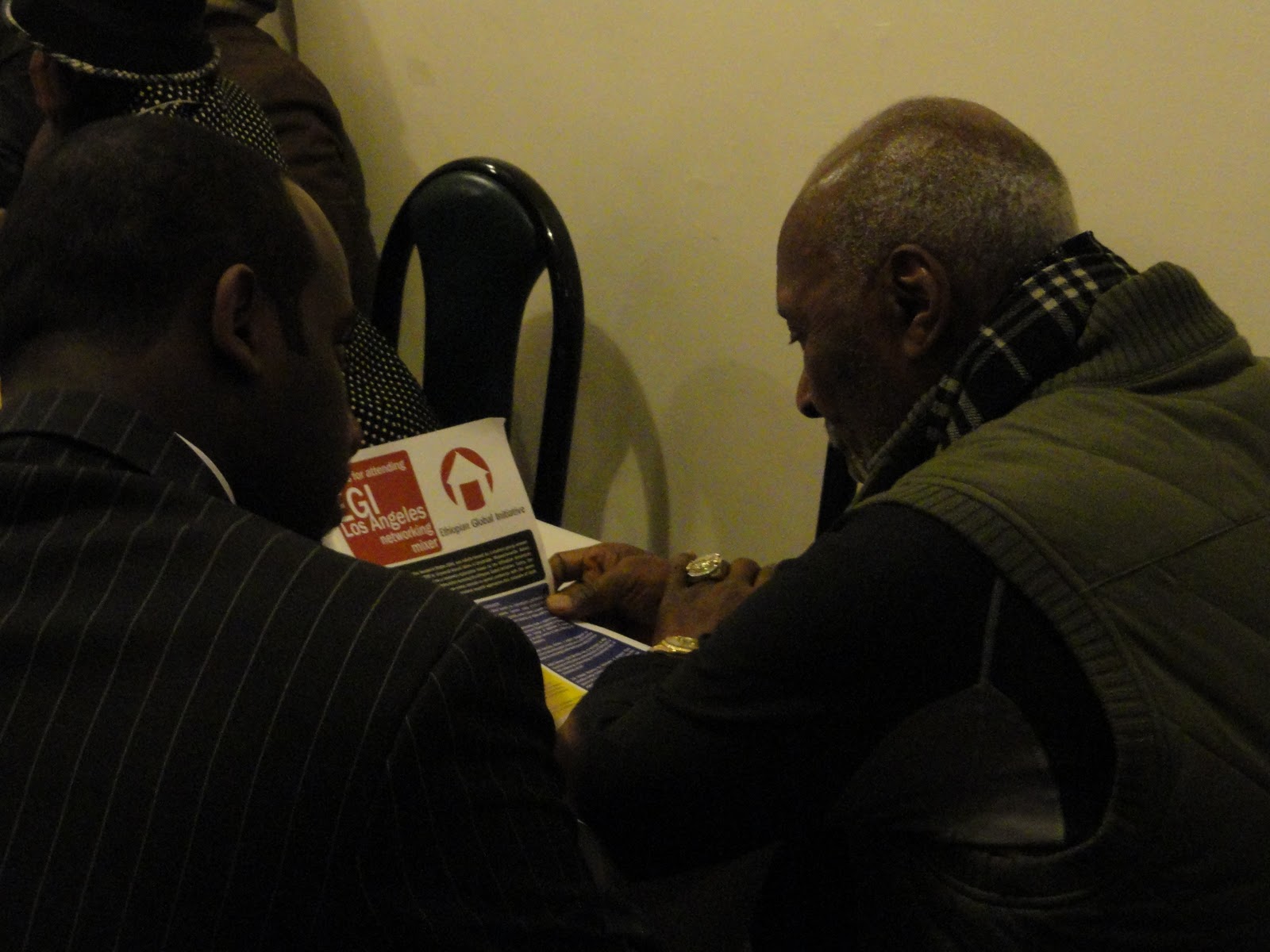
See related press release here. Check out photos from the EGI Los Angeles Networking Mixer here.

EGI's President works with Maryland Ethiopians

Meeting with some members of the Montgomery County
Ethiopian Sister City Committee at Abyssinian
Ethiopian Restaurant. Photo Source: click here.
This past weekend, our President was in Washington, D.C. One of the things he did was meet with representatives of the Montgomery County Ethiopian Sister City Committee. The meeting took place at Abyssinia Ethiopian Restaurant in Silver Spring, Maryland. Check out Samuel's thoughts on the meeting here.

Saturday, February 26, 2011

Ethiopian Global Initiative Successfully Hosts Los Angeles Networking Mixer

EGI President Samuel Gebru discusses with retired
Los Angeles City Councillor Nate Holden on EGI's
work for 2011 and how he could get involved.
FOR IMMEDIATE RELEASE

Los Angeles, Calif., USA, February 26, 2011 – The Ethiopian Global Initiative (EGI), an international nonprofit organization that operates in several countries, successfully hosted its first U.S. West Coast event in the Little Ethiopia district of Los Angeles yesterday, February 25.

“The EGI Los Angeles Networking Mixer was our first outreach event in the West Coast and despite the weather it went very well,” said EGI President Samuel Gebru.

Berhanu and Getahun Asfaw, brothers and co-owners of Messob Restaurant, agreed. Encouraged by EGI’s vision, they welcomed the organization to host the networking mixer at their restaurant.

Berhanu Asfaw, who serves as President of the Little Ethiopia Business Association, welcomed EGI to Los Angeles for future events pledging to assist the organization. “You are doing great work and we will help connect you with the community here so that EGI’s mission expands to all people,” said Berhanu.

Prominent community members attended the networking mixer, including the leading filmmaker in Ethiopia, Theodros Teshome, who recently directed the movie Abay vs. Vegas that aired in the 19th Annual Pan African Film Festival.

The event featured retired Los Angeles City Council Member and the father of Little Ethiopia, the Honorable Nate Holden. Councillor Holden praised EGI’s vision and expressed his deepest appreciation for the work it aims to achieve.

When learning more about EGI’s beginnings, Holden jokingly said, “Samuel, I was about 9-years-old when I became active in my community, so you’re late to have started at 13.”

Holden endorsed EGI, agreeing that U.S. College Students for Ethiopia, its project designed to send college students to Ethiopia on intern and volunteer opportunities, is a great way to begin reversing the brain drain that damaged Ethiopia particularly between 1980 and 1991.

“EGI is doing a great working in terms of recruiting young people…to participate in supporting social programs not only for just EGI but also for Ethiopia.” He underscored his desire to help, declaring, “In fact, I plan to join them!”

The President of the Ethiopian American Chamber of Commerce, Negest Legesse, shared her willingness to work with EGI, particularly on its project the Ethiopian American Census. “We have done a lot of work in the 2010 U.S. Census and to count all Ethiopians in the United States is our goal. I am happy to share what we have done with EGI so that we can begin the steps to form a nationwide partnership,” she said.

Representatives from other nonprofits and businesses were also in attendance. They thanked EGI for the networking mixer and said that it was a prime opportunity to begin discussions on how to collaborate with others.

EGI plans to continue hosting networking mixers with partner organizations and its friends, working to expand its global reach. The events will revive existing connections and build new ones that will enrich the work of EGI.

About the Ethiopian Global Initiative
The Ethiopian Global Initiative is an international nonprofit organization that combines and captures the social and intellectual capital of students and professionals for the transformation of Ethiopia through a new generation of socially responsible leaders. Working throughout the world, the Initiative serves as a catalyst for community-based projects to promote civic engagement and economic prosperity.

Media Contact
action@ethgi.org
+1-617-528-9434

###

Thursday, February 24, 2011

Ethiopian Global Initiative to Host Los Angeles Networking Mixer in Little Ethiopia

Click to enlarge.
FOR IMMEDIATE RELEASE

Los Angeles, Calif., USA, February 24, 2011 – The Ethiopian Global Initiative (EGI), an international nonprofit organization that operates in several countries, will host a networking mixer in the Little Ethiopia district of Los Angeles, California on Friday, February 25 at 6:00pm. 

The event will feature EGI President Samuel Gebru, who will be joined by some of the leading members of the Los Angeles Ethiopian community as well as several business, cultural and academic community members. 

Samuel underscored the importance of the networking mixer. “EGI aims to attract driven people to this networking mixer who are willing and can contribute their skills to the growth of EGI and Ethiopia,” adding that, “this event is purposefully open to people young and old, Ethiopian and not, so we can spread awareness about EGI’s work for 2011.”

The President of the Little Ethiopia Business Association, Berhanu Asfaw, congratulated EGI, saying that it was high time for the community to utilize their skills for Ethiopia. “Messob is very happy to host the Ethiopian Global Initiative in Little Ethiopia tomorrow.”

EGI plans to continue hosting networking mixers with partner organizations and its friends, working to expand its global reach. The events will revive existing connections and build new ones that will enrich the work of EGI.

The networking mixer will be held on Friday, February 25 at 6:00pm at Little Ethiopia’s Messob Restaurant on 1041 South Fairfax Avenue. Visit www.ethgi.org for more information.

About the Ethiopian Global Initiative
The Ethiopian Global Initiative is an international nonprofit organization that combines and captures the social and intellectual capital of students and professionals for the transformation of Ethiopia through a new generation of socially responsible leaders. Working throughout the world, the Initiative serves as a catalyst for community-based projects to promote civic engagement and economic prosperity.

Media Contact
action@ethgi.org 
+1-617-528-9434

###

Important Information

© 2010 Ethiopian Global Initiative, Inc. Material may be republished with credit to this blog and/or the original author. The views and comments expressed in this blog are not necessarily those of the Ethiopian Global Initiative, Inc.