Showing posts with label Ethiopian Diaspora. Show all posts

Sunday, July 29, 2012

Bypassing Politics? A Meeting with Ethiopia’s President


Mr. Samuel M. Gebru, CEO of the Ethiopian Global
Initiative and H.E. Girma Woldegiorgis, President of the
Federal Democratic Republic of Ethiopia. (Photo: Grand Palace)
Samuel M. Gebru (@SMGebru)
Addis Ababa, Ethiopia
July 29, 2012

It was an honor to be invited to the Grand Palace on Friday, July 20 to meet with the President of Ethiopia.

Girma Woldegiorgis, born in 1925, is currently 88-years-old and despite his age and health issues, his passion and service for Ethiopia is as young as my college-aged heart.

When I was told that I had an opportunity to meet with Ethiopia’s Head of State, I readily took the opportunity. While most discount the President of Ethiopia as a mere figurehead resembling Britain’s Queen Elizabeth II, I would argue that—just like the Queen—the President is what should hold the national fabric together as head of the Ethiopian state.

In 2010, I mistakenly argued that the government should do away with the Presidency because I thought it had no clear purpose. I have come to learn that it is the President who should inspire a new generation of public servants through his/her own merits. And who better than Girma Woldegiorgis for this role?

Sure, he has had his fair share of health issues and at one point was rumored to have died (although I can assure you that he’s alive and kicking!), Girma Woldegiorgis has the resume fit for the Ethiopian Presidency. Beyond his ability to speak seven languages, of which three are Ethiopian (Oromiffia, Amharic and Tigrinya), the President has been a lifetime public servant since his youth.

As I walked into the Grand Palace, built for Ethiopia’s last monarch, I was stunned by the magnificent Judeo-Christian motifs. From the rugs to the ceilings to the President’s desk, formerly the Emperor’s, the Grand Palace was a magnificent display of the ancient ties Ethiopia has to Christianity, Judaism and Israel.

Already briefed on me, the President expressed happiness to receive someone my age. I told him that it was hard for many like me to be taken seriously because of our age and that one needs old age and a title before receiving respect in Ethiopian society. He interrupted me and disagreed. He reminded me that he was 36 when he became Speaker of the Chamber of Deputies of Ethiopia’s Imperial Parliament in 1961 and that he was my age when he was called to national service in the Imperial Air Force, earning the rank of Lieutenant. 

In our meeting, I briefed President Girma on the Ethiopian Global Initiative’s vision for Ethiopia. He was very happy to learn that the organization’s core is built of students and professionals ranging from 18 to 35-years-old. I informed him how the Initiative aims to increase its presence in Ethiopia and undertake more programs and projects in healthcare, education, civic engagement and economic development. 
President Girma Woldegiorgis shows CEO Samuel Gebru
his Lem Ethiopia membership card. (Photo: Grand Palace)
President Girma is a noted environmentalist. As Speaker of Parliament, he designed the first environmental legislation in Ethiopia—perhaps one of the first in Africa. In March 1992, he founded Lem Ethiopia (The Environment and Development Society of Ethiopia), Ethiopia’s premiere civil society organization responsible for the protection of the environment. 

What impresses me the most about President Girma is his ability to bypass Ethiopia’s unpredictable political system and work with all governments. His transcendence of the Governments of Haile Selassie, Mengistu Hailemariam and Meles Zenawi is truly remarkable—and that he has earned everyone’s respect in the process. 

At the end, I asked President Girma what was the best advice he could give me. He said, “Continue what you are doing in meeting people from all sectors and backgrounds and learn more from them. It is only then can you become an effective public servant.”

I look forward to many more encounters with the President and wish him and the First Lady my warmest regards.

Samuel M. Gebru is 20-years-old and the Chief Executive Officer of the Ethiopian Global Initiative.

Friday, May 25, 2012

Africa’s Brain Drain: Hopeless to Hopeful

By: Samuel M. Gebru (@SMGebru)
May 25, 2012

This article is an abbreviated version of a keynote address the author delivered at the Minnesota State University, Moorhead’s African Night on February 25, 2012.

“What can I bring to Africa?” “How can I help Africa?” These are frequently asked questions by people who are concerned about the political, economic and social development of Africa. Once dubbed the “hopeless continent” by The Economist, ten years later, The Economist is now correcting itself calling Africa the “hopeful continent.”

All around the world, people are awakening their curiosity to learn more about Africa. Often mistaken for a country, the African continent is home to a rich, diverse and driven people. In this article, I will first examine the causes and consequences of a global phenomenon that has deeply affected Africa known as the “brain drain.” Secondly, I will discuss the importance of the “brain gain” as a reversal to the negative impacts of Africa’s brain drain. Thirdly, I will share why the new concept of “brain circulation” is Africa’s latest weapon for success. Lastly, I will attempt to answer my initial question: “What can I bring to Africa?”

The brain drain is a global phenomenon where large amounts of the highly skilled and talented population of a country leave and migrate to another country for better opportunities. The brain drain is a significant problem affecting many developing countries.

Since the 1960s, Africa has experienced at great numbers the massive exodus of its skilled and talented workforce to other parts of the world. The brain drain occurs in three settings: internally, regionally and globally. On the global level, Africa’s brain drain occurs in two major settings. First is where individuals complete their education in Africa and migrate overseas for various political, economic and social reasons. Second is where African students who study abroad stay abroad after graduation and permanently settle into their new lifestyles. 

In both settings, Africa looses because its skilled population is leaving. In my native Ethiopia, the United Nations Development Programme estimates that between 1980 and 1991 Ethiopia lost over 75% of its skilled workforce. Imagine in just about one decade loosing the overwhelming majority of your country’s talented scientists, engineers, physicians, entrepreneurs, educators and attorneys. Indeed, this is a loss for the continent.

Arguably, the main causes of Africa’s brain drain include economic inequality between Africa and the rest of the world; political instability that threatens the safety and freedom of a country’s skilled workforce; and the colonial legacy and postcolonial mentality of Africa.

Economic inequality between Africa and the rest of the world is perhaps the most obvious reason for Africa’s brain drain. In the internal setting, a brain drain occurs when skilled people move from one part to another, more developed and urban part of a country. Similarly, at the global setting, a brain drain occurs when skilled people move from Africa to more developed parts of the world, such as North America, Western Europe and now Southeast Asia. These people, escaping the poverty and lack of perceived or real opportunities in Africa, find life in their new settings. Because Africa is comparatively underdeveloped and less industrialized, it looses.

Political instability is another obvious reason for Africa’s brain drain. Africa has seen its fair share of political strife, civil wars, religious conflict, anarchy and blatant disregard for human rights and the rule of law. These series of political factors are intolerable to all Africans, but in particular to those that make up the skilled and talented workforce. Bloody wars in countries like Sudan, Liberia, Ethiopia, Rwanda and Angola speed the brain drain by forcing out skilled workers and social activists. 

Lastly, the colonial legacy and postcolonial mentality of Africa strongly contribute to Africa’s brain drain. Because of the hundreds of years that Africa was subjected to a Eurocentric vision of the world, it has now become internalized in many societies that Africa has no returns for the skilled, and that it is indeed a hopeless continent. African professionals want to offer their services wherever they can receive the highest value in returns instead of embracing the Afrocentric viewpoint, which includes service to one’s community, a community-oriented method of living and a strong embracement of spiritual values. This is, of course, not to say that the Eurocentric vision of the world does not include these viewpoints, but I would argue that these viewpoints are central to African societies. Because of the internalization of the Eurocentric vision, many African professionals view no opportunities for growth in Africa and thus leave.

The consequences of the brain drain are many, but most importantly, Africa looses its human capital—its brain. Africa is deprived of the cutting-edge advancements that its professionals are making abroad for overseas companies and countries. Ultimately, the political, economic and social development of Africa is greatly stalled because the driving force is nowhere to be found.

The brain gain is the other side of the story: where large amounts of the highly skilled and talented population of a country leave and migrate to another country for better opportunities. Does this sound like the brain drain? Yes, because it is the brain drain, but only from the perspective of the one who is gaining and not draining.

The brain gain is most commonly witnessed in the United States. The United States has always been a destination for opportunity, a place where one has a real chance of claiming their piece of the American Dream.

In recent years, however, many skilled and talented Africans and non-Africans alike have started to migrate to the African continent. This phenomenon known as the brain gain reaps positive benefits for the continent because it is a reversal of the loss Africa has suffered. While the 1960s is typically known as the so-called start of the brain drain, Africa has suffered under the brain drain since the era of enslavement hundreds of years ago.

The brain gain offers new promise for Africa. Now being recognized as a continent of hope and opportunity, there is much to be said about Africa’s promise. Technological, political, economic and scientific advancements have placed Africa at a greater forefront than it ever was. Indeed, it is also known as “the last global frontier” in terms of its largely untapped reserve of natural resources. Unprecedented developments in information and communication technology (ICT) have completely overhauled the way Africa’s human capital operates and mobilizes. Investment in ICT allows for greater economic activity and development, attracting the attention of those living abroad that seek greater opportunities.

In the same manner that African professionals are leaving Africa and African students that study abroad are staying abroad, the process is now being reversed to where African students and professionals are returning to rebuild what was lost in their absence. The new generation of Africans is becoming aware of their modern history and of the triumphs and tragedies that Africa has faced in the past centuries. However, more important is that the new generation of Africans is awakening to the opportunities that lie ahead for Africa and is realizing that to make a positive and proactive difference, they must be the driving force behind those opportunities.

African governments are now realizing that not all students and professionals living abroad want to return. Some members of the African diaspora have settled comfortably for many years in their new adopted homelands, be it in the United States or elsewhere. Because of this, new incentives are being created and many governments in Africa have stared to open offices dealing directly with capturing the skill and talent of the diaspora. Correctly so, an increasing number of African countries consider their highly qualified nationals living abroad as an asset for national development.

The brain circulation is Africa’s latest weapon for success because one does not need to be in Africa to help rebuild Africa. Unlike the brain gain or the brain drain, the brain circulation is not a black-or-white phenomenon; it allows much room for creativity and innovation. The impact of the ICT sector is very evident in brain circulation. For example, Skype, Cisco Systems and other video and telephone conference services have allowed African and non-African professionals and students living abroad the opportunity to simultaneously connect with those who live in the continent. 

Advancements in tele-education have allowed professors from India the opportunity to teach courses in universities in countries like Ethiopia and South Africa without having to physically be there. Connected through video conferencing, these Indian professors are able to circulate their brain with students in Ethiopia and South Africa. 

Likewise, advancements in tele-medicine have allowed physicians in Kenya to diagnose patients with the medical help of physicians in the United States who are viewing these medical files through real time connection.

Virtual colleges and hospitals are just two examples of the advancements made through investing in the ICT sector in Africa. This allows mankind the opportunity for brain circulation without national or political barriers preventing us from communicating with one another. One does not need to live in Kenya, or be Kenyan to support the country’s development. Likewise, one does not need to live in Nigeria, Africa’s top oil producer, to help advise the government on new energy technologies and strategies. We can do this using our fingertips, laptops and mobile phones.

African governments are now realizing that the strength of its lost workforce does not need to return permanently to help rebuild the continent. National projects building roads and telecommunications systems are now being led and advised by the African diaspora. Without the effective involvement of the African diaspora, it is highly unlikely that any long-term results will be achieved. 

The forced removal of millions of Africans through enslavement is now being undone through the opportunities in brain circulation. The African diaspora with its resources and skills will be able to mobilize quickly and simply because we live in the information era. Otherwise known as the knowledge era, the information era thrives through the creation, manipulation, consumption and teaching of knowledge. This knowledge—this brain—is now a force that cannot be stalled at an airport because one cannot get a passport to enter Sudan or Zimbabwe. Rather, this knowledge is active through real time technology that allows us to be here and there, and consequently, everywhere.

Now that I have discussed the brain drain, brain gain and brain circulation, I would like to attempt to answer my initial question: “What can I bring to Africa?” Africa, once a byword for hopeless, poverty and famine, is moving forward through the strategic investment of knowledge. 

At the Ethiopian Global Initiative, the nonprofit I founded, our mission statement identifies two important things that we all can bring to Africa. First, our social capital: the value of networks, the value of who you know. Secondly, our intellectual capital: the value of human knowledge, the value of what you know. Social capital is important because it determines our ability to build and foster relationships and our ability to use those relationships for good. “Good” can include human rights, development, peace and cultural preservation. Intellectual capital, the value of human knowledge and resources, includes your skills, experiences and how competent you are. Intellectual capital has two important components, human capital—the individual—and structural capital—the society.

By harnessing our collective capital, by bringing it together in one brain trust, we bring to Africa one word: transformation. Because the intellectual diaspora can be tapped virtually wherever located, we as Africans and non-Africans alike, have the distinct opportunity of engaging Africa half a world away without ever leaving our bedrooms. 

The transformation we bring to Africa is manifested through political, economic and social development because our collective capital becomes Africa’s latest weapon for success. Understanding the importance of and utilizing our social and intellectual capital will allow greater influence in the political affairs, economic prosperity and social development of Africa. What Africa needs most is not aid, it is not even trade; it is the skilled and determined people to uproot the continent to realize its full potential. 

Your social and intellectual capital and the transformation we can collectively cause through it is what you can bring to Africa.

Just as it takes a village to raise a child, it takes a people to raise a continent.

Samuel M. Gebru is the President and Chairman of the Ethiopian Global Initiative.

Wednesday, December 28, 2011

Hakuna Sundays: Boston Area Networking Mixer

Click on the photo to enlarge

Sunday, January 8, 2012 from 6:00pm until 9:00pm
Harvard Yard Starbucks
1380 Massachusetts Ave.
Cambridge, Massachusetts 02138

Come attend the first Hakuna Sundays networking mixer of 2012 co-hosted by Africans in Boston (AiB) and the Ethiopian Global Initiative (EGI). Hakuna Sundays is an AiB bi-weekly networking mixer open for all students and professionals in the Boston area. Mingle with new and familiar faces while sipping on complementary Ethiopian coffee provided by Harvard Yard Starbucks.

More information and RSVP: action@ethgi.org or 1-617-528-9434

Sunday, October 30, 2011

Free Societies Inspire Engagement

Photo: Dawn Colquitt-Anderson/EGI
By: Bethel Tsehai, M.P.H. (@bethel_tsehai)
October 30, 2011

A week ago, on Saturday, October 22, I attended the Ethiopian Global Initiative’s 2011 BuildEthiopia Conference at Harvard University. BuildEthiopia provided a platform for participants and attendees to actively engage in exploring current issues facing Ethiopia and to seek solutions for those challenges. Students, professionals, educators, policy makers, activists, and community organizers came together to collaborative and mutually inspire.

Topics covered include social entrepreneurship and economic development, civic engagement, and exploring the millennium development goals in relation to Ethiopia. Mr. Tesfaye Yilma, Deputy Chief of Mission of the Embassy of Ethiopia to the United States, spoke on the various threats Ethiopia faces in the future, in particular, poverty as the country’s top national security threat. On the positive side, the government is making efforts to ensure a transfer of knowledge and technology.

Mr. David Rice, Executive Director of New York University’s Development Research Institute, emphasized the need for and benefits of economic freedom in Ethiopia. Often times, international development issues stem from issues in leadership. In light of this statement, he asked some thought provoking and profound questions. In particular, he asked, “Can you have economic freedom and growth without criticizing the current government?” It’s imperative to realize that only in a free society does a country have complete economic freedom. He asked, “Could Steve Jobs do what he did in Ethiopia?” Think about it! In a free society, citizens are not only empowered, but entitled to pursue their dreams without hindrance. Failure or success of the individual is based on their own efforts and abilities and not dictated or controlled by the government.

On the bright side, Ethiopia’s GDP is growing at a progressive double-digit rate. In light of this growth, it is vital for donor countries to partner with the African Diaspora. It is clear that Africa needs an African solution! Frankly, the African Diaspora needs to step and think outside the box and develop new and innovative ways to approach the difficulties of Ethiopia and Africa in general.

Through capacity building, enhancing social media and technology, and engaging in social entrepreneurship, Ethiopia will become a self-sustaining and successful country. There is hope and it begins with one word: ENGAGEMENT!

Bethel Tsehai, M.P.H., is Project Manager of the Midwives Scholarship Fund at the Ethiopian Global Initiative.

Thursday, October 27, 2011

Sustainable Programs that Empower

Photo: Oxfam America
By: Abel Tadesse, M.H.S. (@Abel_Says)
October 27, 2011

I came across an article published on October 24, 2011 by Oxfam America entitled With Insurance, Loans, and Confidence, this Ethiopian Farmer builds her resilience. These are the kind of stories that I love to read as it gives hope and allows an individual to see the glimpse of the light at the end of the tunnel.

There is definitely hope for Ethiopians that depend on agriculture and livestock as long as there is a system to support their long-term needs. For example, Selas Samson Biru from the article is a farmer who participated in a crop insurance program where she was able to secure "payout for a crop" insurance in case harvesting fails due to drought. Further, the Oxfam America program opened the door to financial loan options. Surely enough, the program continues to provide support, guidance and encouragement to Ethiopian farmers. In Selas' case, she was even able to take advantage of the loan program to obtain "her own pump" to help in irrigation system for her crops. These programs exemplify that any human being can learn and apply smart sustainable investment practices as long as there is a seed of empowerment.

The article mentions challenges such as expensive fertilizers. It is also evident that there is inaccessibility of such programs to other regions of Ethiopia and the ongoing drought in Horn of Africa is not helping the conditions as well. However, these shouldn't be a surprise to us and become an obstacle to our work towards development. Rather, we should learn from these positive stories and pursue innovative programs that continue the efforts to develop financial and human resources. Of particular importance is the intellectual capital of the Ethiopian diaspora.

It is undeniable that the diaspora has an abundance of experts familiar with Ethiopia's condition and can deliver intellectual and financial support. To use these resources efficiently, it will be important to create social awareness through various channels such as networking events and conferences that nurture collaboration and attract individuals and organizations that aim to implement sustainable programs that educate and empower Ethiopians.

As exhibited in the Ethiopian Global Initiative’s 2011 BuildEthiopia Conference on October 22 at Harvard University, EGI also contributes to improve the lives of Ethiopian communities in Ethiopia and abroad by setting the value of networking, sharing ideas, learning as well as motivating and collaborating with organizations and individuals for the betterment of Ethiopia.

Abel Tadesse, M.H.S., is Director of Project Development of the Ethiopian Global Initiative.

Tuesday, October 4, 2011

Conference Preparation is Building Up!

Preparation for the 2011 BuildEthiopia Conference is fully underway. We are especially grateful for the support we are receiving from the Harvard University African Students Association, our Venue Sponsor.

Today we confirmed our conference rooms and venue for October 22. We will be using Maxwell Dworkin Hall, Harvard University's home for the Division of Engineering and Applied Sciences, as the conference venue. 

Maxwell Dworkin Hall was built in honor of the mothers of Microsoft Chairman William H. Gates, III and Microsoft President Steven A. Ballmer. As home of engineering and applied sciences, Maxwell Dworkin Hall symbolizes the importance of building Ethiopia though not only engineering but also envisioneering ideas for the future.

Click here for more information on the conference and to register online for free!

Wednesday, April 20, 2011

EGI New York Fundraiser


The Ethiopian Global Initiative is hosting a fundraiser and networking mixer on Sunday, May 1, 2011 at 6:00pm in New York City. You're invited to enjoy dinner at Awash Ethiopian Restaurant and a portion of your bill will be given to EGI! 

Support an international organization of students and professionals dedicated to launching and supporting innovative social programs in Ethiopia. Learn more by visiting www.ethgi.org and joining us on facebook at www.facebook.com/ethgi.

Awash Ethiopian Restaurant
947 Amsterdam Ave
(between 106th St & 107th St)
New York, NY 10025
Manhattan Valley
Nearest Transit: 103rd Street (1), Cathedral Parkway (B, C)

Questions? Call EGI at 617-528-9434 or email action@ethgi.org.

Wednesday, March 2, 2011

City Councillor Nate Holden supports the Ethiopian Global Initiative


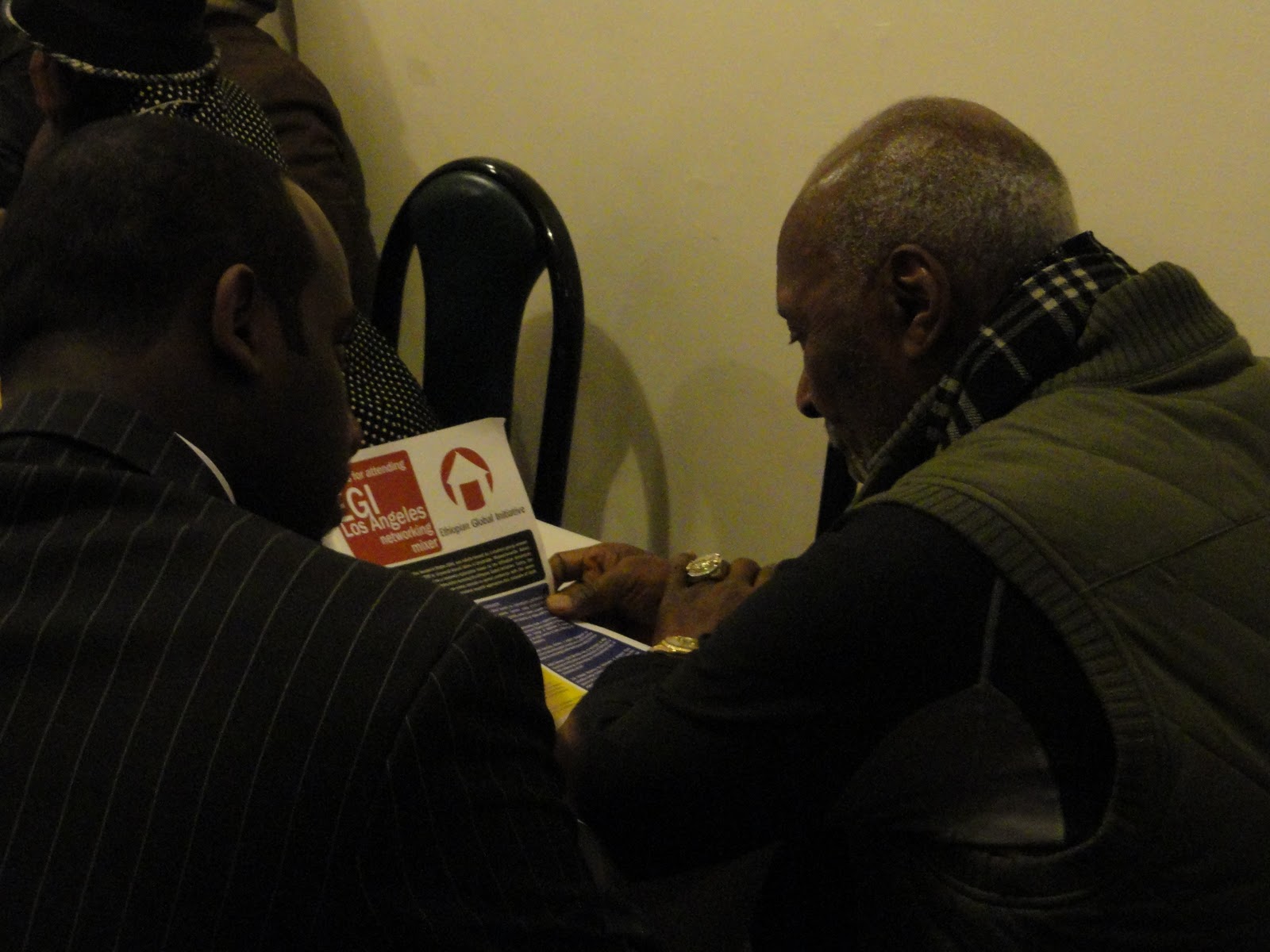
See related press release here. Check out photos from the EGI Los Angeles Networking Mixer here.

EGI's President works with Maryland Ethiopians

Meeting with some members of the Montgomery County
Ethiopian Sister City Committee at Abyssinian
Ethiopian Restaurant. Photo Source: click here.
This past weekend, our President was in Washington, D.C. One of the things he did was meet with representatives of the Montgomery County Ethiopian Sister City Committee. The meeting took place at Abyssinia Ethiopian Restaurant in Silver Spring, Maryland. Check out Samuel's thoughts on the meeting here.

Saturday, February 26, 2011

Ethiopian Global Initiative Successfully Hosts Los Angeles Networking Mixer

EGI President Samuel Gebru discusses with retired
Los Angeles City Councillor Nate Holden on EGI's
work for 2011 and how he could get involved.
FOR IMMEDIATE RELEASE

Los Angeles, Calif., USA, February 26, 2011 – The Ethiopian Global Initiative (EGI), an international nonprofit organization that operates in several countries, successfully hosted its first U.S. West Coast event in the Little Ethiopia district of Los Angeles yesterday, February 25.

“The EGI Los Angeles Networking Mixer was our first outreach event in the West Coast and despite the weather it went very well,” said EGI President Samuel Gebru.

Berhanu and Getahun Asfaw, brothers and co-owners of Messob Restaurant, agreed. Encouraged by EGI’s vision, they welcomed the organization to host the networking mixer at their restaurant.

Berhanu Asfaw, who serves as President of the Little Ethiopia Business Association, welcomed EGI to Los Angeles for future events pledging to assist the organization. “You are doing great work and we will help connect you with the community here so that EGI’s mission expands to all people,” said Berhanu.

Prominent community members attended the networking mixer, including the leading filmmaker in Ethiopia, Theodros Teshome, who recently directed the movie Abay vs. Vegas that aired in the 19th Annual Pan African Film Festival.

The event featured retired Los Angeles City Council Member and the father of Little Ethiopia, the Honorable Nate Holden. Councillor Holden praised EGI’s vision and expressed his deepest appreciation for the work it aims to achieve.

When learning more about EGI’s beginnings, Holden jokingly said, “Samuel, I was about 9-years-old when I became active in my community, so you’re late to have started at 13.”

Holden endorsed EGI, agreeing that U.S. College Students for Ethiopia, its project designed to send college students to Ethiopia on intern and volunteer opportunities, is a great way to begin reversing the brain drain that damaged Ethiopia particularly between 1980 and 1991.

“EGI is doing a great working in terms of recruiting young people…to participate in supporting social programs not only for just EGI but also for Ethiopia.” He underscored his desire to help, declaring, “In fact, I plan to join them!”

The President of the Ethiopian American Chamber of Commerce, Negest Legesse, shared her willingness to work with EGI, particularly on its project the Ethiopian American Census. “We have done a lot of work in the 2010 U.S. Census and to count all Ethiopians in the United States is our goal. I am happy to share what we have done with EGI so that we can begin the steps to form a nationwide partnership,” she said.

Representatives from other nonprofits and businesses were also in attendance. They thanked EGI for the networking mixer and said that it was a prime opportunity to begin discussions on how to collaborate with others.

EGI plans to continue hosting networking mixers with partner organizations and its friends, working to expand its global reach. The events will revive existing connections and build new ones that will enrich the work of EGI.

About the Ethiopian Global Initiative
The Ethiopian Global Initiative is an international nonprofit organization that combines and captures the social and intellectual capital of students and professionals for the transformation of Ethiopia through a new generation of socially responsible leaders. Working throughout the world, the Initiative serves as a catalyst for community-based projects to promote civic engagement and economic prosperity.

Media Contact
action@ethgi.org
+1-617-528-9434

###

Thursday, February 24, 2011

Ethiopian Global Initiative to Host Los Angeles Networking Mixer in Little Ethiopia

Click to enlarge.
FOR IMMEDIATE RELEASE

Los Angeles, Calif., USA, February 24, 2011 – The Ethiopian Global Initiative (EGI), an international nonprofit organization that operates in several countries, will host a networking mixer in the Little Ethiopia district of Los Angeles, California on Friday, February 25 at 6:00pm. 

The event will feature EGI President Samuel Gebru, who will be joined by some of the leading members of the Los Angeles Ethiopian community as well as several business, cultural and academic community members. 

Samuel underscored the importance of the networking mixer. “EGI aims to attract driven people to this networking mixer who are willing and can contribute their skills to the growth of EGI and Ethiopia,” adding that, “this event is purposefully open to people young and old, Ethiopian and not, so we can spread awareness about EGI’s work for 2011.”

The President of the Little Ethiopia Business Association, Berhanu Asfaw, congratulated EGI, saying that it was high time for the community to utilize their skills for Ethiopia. “Messob is very happy to host the Ethiopian Global Initiative in Little Ethiopia tomorrow.”

EGI plans to continue hosting networking mixers with partner organizations and its friends, working to expand its global reach. The events will revive existing connections and build new ones that will enrich the work of EGI.

The networking mixer will be held on Friday, February 25 at 6:00pm at Little Ethiopia’s Messob Restaurant on 1041 South Fairfax Avenue. Visit www.ethgi.org for more information.

About the Ethiopian Global Initiative
The Ethiopian Global Initiative is an international nonprofit organization that combines and captures the social and intellectual capital of students and professionals for the transformation of Ethiopia through a new generation of socially responsible leaders. Working throughout the world, the Initiative serves as a catalyst for community-based projects to promote civic engagement and economic prosperity.

Media Contact
action@ethgi.org 
+1-617-528-9434

###

Monday, December 6, 2010

Exploring Ethiopia at Olivet

President Samuel M. Gebru poses for a picture following
his presentation and is joined by Olivet Pastor Kris Gorden
and other members of the Ethiopia delegation.
Photo: Lori Bakken
By: Samuel M. Gebru
December 6, 2010

I went to Olivet Lutheran Church in Fargo, North Dakota, yesterday afternoon to speak about the Ethiopian Global Initiative and Ethiopian history and culture. 

Having been invited to speak by members of the Olivet delegation to Ethiopia, I enthusiastically accepted the invitation as an opportunity to share the richness of Ethiopia. The group, composed of young and old, is a cross-section of various professions and interests.

My presentation, entitled "Exploring Ethiopia," gave the group an overview of the Ethiopian Global Initiative's history, mission and projects. I highlighted the importance of building a global coalition of like-minded thinkers who share one thing in common: an affection towards Ethiopia. 

Since the group is going to Ethiopia for the first time, with the exception of one adult who previously adopted two young girls from Ethiopia, I gave an overview of the country. Beginning from the geography, explaining that Ethiopia is about twice the size of the U.S. state of Texas, I took the group 5,000 years back to describe an ancient empire that controlled the Red Sea and traded with other empires as far as India and China. 

I also went over certain customs and traditions that Ethiopians consider to be very important; whether it is how to properly greet others or to partaking in the Ethiopian coffee ceremony, customs are very important in Ethiopia. It was fun going over the practice to prepare food and insist that your guests eat, even if they claim that they are not hungry, which is also customary to claim you are not hungry even if you are! A sort of back-and-forth exchange ensues before the guest accepts the food.

Following my presentation, I had the opportunity to answer questions from the delegation members and I also asked them questions about their goals in going to Ethiopia. Their goals ranged from learning more about Ethiopia to finally meeting the orphans they have sponsored at the Kolfe Boys Orphanage in Addis Ababa for some years now.

Most importantly is their continued involvement in Ethiopia. I encouraged them to become Ambassadors of Ethiopia when they return to the United States; to share their experience with their families, Church community, colleagues and friends. Not only do they serve as Ambassadors of Olivet when going to Ethiopia but they return to the United States with a duel perspective.

They all agreed that at the end, we're all just that--Ethiopians.

Saturday, November 27, 2010

Misplaced Priorities of the Ethiopian Diaspora

By: Samuel M. Gebru
November 28, 2010

Author’s Note: This article was inspired by the conversations I had with members of my family over the past two days. During the Thanksgiving weekend, we discussed much about keeping the culture of our native homeland Ethiopia and ethnic group while living in the United States. I have added much to this article, particularly in my conclusion on using the Ethiopian Global Initiative’s mission statement as a possible action plan, but the basis was from our conversations.


BACKGROUND
According to the United Nations Development Program, Ethiopia lost over 75% of its skilled workforce between 1980 and 1991. These were the years of the civil war, when Ethiopia was governed by Marxist ideologies. Before the fall of Emperor Haile Selassie in 1974, most Ethiopians in the United States were either students or businessmen. There was hardly an immigrant community of any strong number.

Since our Marxist days, Ethiopians have left to many other countries in search of improving their lives and leaving the political, economic and social issues that continue to constrain Ethiopia. Many Ethiopians have been victim to countless traumatic events. What used to be a community of temporary students and businessmen became a community of immigrants and refugees.

As the Ethiopian diaspora increased from war-to-war, revolution-to-revolution, so did social and economic concerns. Ethiopian adults, both educated and uneducated, found it very difficult to find meaningful employment in their adopted homelands. Many Ethiopian Medical Doctors, for instance, had to retake courses to satisfy American requirements. Ethiopians who were teachers in their homelands became parking lot attendants for American sporting events. It was back to zero for many in the Ethiopian diaspora.

The unanswered problem was the social aspect. Without a doubt, Ethiopians face a cultural shock when coming to the United States. Because the community lacks the resources to address those cultural shocks, the economic problems become widespread. While Ethiopian adults were too busy focusing on making ends meet for their immediate families, new expectations of supporting their extended families in Ethiopia grew. The end result is a lack of cultural connection between Ethiopian parents and children.

PROMOTING AND PRESERVING OUR IDENTITY
Faced with two jobs, trying to go to school and learn English and perhaps a vocation while also trying to navigate an entirely new country and culture, Ethiopian parents did not pass on the Ethiopian identity to their children. In a similar article I wrote on July 22, 2010 on my personal blog, We Do Not Know, I asked:

Who do we blame for our lack of knowledge? Can it be the parents? Fine, some blame can go to our parents who seldom teach us anything on Ethiopia—but how much can one expect from people that are struggling to raise us? When you live in a country whose culture and language you have not mastered, it is hard to focus on anything else but getting by. Perhaps it is our community that we should blame. I would reply: what community? Ethiopians seem more divided than united in the diaspora. So there is no community from the onset to blame!

The first responsibility of raising and educating a child goes to a parent. If parents do not actively promote Ethiopian culture to their children, then there will be a knowledge gap. The identity is lost when young Ethiopians are not taught about the big multicultural mosaic known as Ethiopia. Not knowing about their culture is a very troubling reality for many young Ethiopians in the diaspora. Ethiopians should be most proud of their identity; Ethiopia is the only African country to never be colonized, the first country to accept Christianity, a country proclaimed the land of justice by the Islamic Prophet Mohammed, one of the oldest continuously surviving countries and the touted cradle of mankind.

The unique identity of the Ethiopians is not being taught or told in adopted homelands such as the United States. Young Ethiopians should be the first in line to be taught about their identity; before promoting it to non-Ethiopians, Ethiopians should be made aware. So, if the parents are too busy and are struggling night and day to make ends meet for their children, who can teach the young Ethiopians of their history, culture and language?

CREATING A MEANINGFUL COMMUNITY
Little Ethiopia in Los Angeles, California is often cited
as an example of meaningful community
Ethiopians in the diaspora need to draw lessons from other immigrant communities in the United States. The Chinese, Israeli, Mexican and Greek communities have been able to establish themselves in meaningful communities that are free from politics, religion and ethnicity. These communities are united and all share the mutual concern of preserving their native identities in the United States.

The result is phenomenal. Chinatown has become a thing of urban living for many cities throughout the world. The Israeli/Jewish community has become one of the biggest and most politically important communities in the United States through their strong unity and advocacy for their rights. Mexicans and Greeks import their own products to the U.S. to boost commerce, open cultural centers and use their Churches as points of community.

Currently, there are many Ethiopian community organizations established throughout the diaspora that all share the same mission statement. In practice, however, much is to be desired. Nonetheless, the organizations that do strive to bring their divided communities together are never supported enough to accomplish their goals on a big scale. In this case, the result is almost tragic. For instance, we Ethiopians do not have a central place in Washington, D.C. or Boston or Houston to call home; a place that is apolitical, indifferent to one’s ethnic and religious affiliations. The tragedy extends itself when we are faced with major problems, such as death.

The recent and unfortunate death of Ali Mohammed of Washington, D.C., and the outcry of the Ethiopian community that followed, showed me that there is a long way before we are able to deal with problems facing our community. Whether it is defending for our rights or promoting our identity, we face a serious problem with responding to these issues unless we create meaningful community organizations. These organizations should be able to bring all of us in, ethnically and religiously—Tigrayans, Amharas, Oromos, Gambella, Orthodox, Pentecostal, Muslim, Jewish, etc. And if they don’t, then they are not truly commUNITY organizations.

ADVOCATING FOR OURSELVES
Young Ethiopians should advocate for themselves. They should advocate at community meetings and within their churches, demanding to be taught their languages. Amharic is Ethiopia’s official language—we should all learn it. We should also branch out and learn our ethnic group’s language too; and if our ethnic group speaks Amharic as its primary language then we should learn another ethnic Ethiopian language. Language is one of the most important ways to become more culturally competent; language makes it possible to learn more about another culture. Realistically, many Ethiopian youth who don’t know their language travel back to Ethiopia and are as good as deaf.

Advocating for ourselves moves beyond learning their language. The Ethiopian identity extends to our religion, music, traditions and values. This identity is endangered in many of our diaspora communities simply because we as a whole let it happen. Like the Greek and Chinese, we should invest in community centers and “Little Ethiopias” throughout the world that would serve as places where we can keep our culture alive. Parents who do not have the time, resources or knowledge to help their children fully understand the Ethiopian identity could then send their children to these community centers.

We must further this advocacy to include the entire community. Ethiopians must also advocate, as a community, for their rights. We cannot and should not be a reactionary society; it is not Ethiopian culture to be reactive. The Ethiopian identity teaches us that the bravest and most heroic Ethiopians were proactive. When the U.S. Congress meets to debate healthcare reform or immigration reform, Ethiopians should stand as a community and not as individuals to inform the Congress of their opinions. Sadly, the Congressional Caucus on Ethiopia and Ethiopian Americans is not used for these purposes. While they are there to serve as our microphone on Capitol Hill, we either ignore it or misuse it.

NEXT STEPS
Its time for a major change in our thinking. Albert Einstein once said, “You can’t solve a problem with the same thinking that caused the problem.” Our current thinking is of separation and self-interest. In order to continue the Ethiopian identity, we must proactively promote it by teaching each other and, in turn, teaching the rest of the world. Our priorities are misplaced. We have focused too much about what happens in Ethiopia while we forgot about how our communities are living abroad. Surely this is not a call to abandon everything in the native homeland—to do this would be unthinkable!

The next steps are to build bridges with one another and share ideas and solutions. Since the blame game is neither effective nor efficient, we cannot point fingers at this group or that group. The most important thing now is to be proactive and think about tomorrow and the challenges the Ethiopian diaspora will face then.

In the June 2010 conference of the Ethiopian American Youth Initiative, now Ethiopian Global Initiative (EGI), much was discussed about the disillusion of Ethiopian youth in the diaspora, particularly the United States. Encounters with the Justice System and teen pregnancy were discussed as two very noticeable ways that the Ethiopian youth are being negatively impacted. Having strong communities that are able to keep the youth out of trouble and in positive atmospheres is what we need. Two prominent examples of this are seen with Young Diplomats in Toronto and the Debre Selam Kidest Mariam Ethiopian Orthodox Tewahedo Church Mentorship Program in Washington, D.C.

My next step is to challenge you, as the reader, to act. The 2011 EGI Global Summit host university will be announced shortly and that will be a prime venue to discuss solutions to problems that the Ethiopian diaspora faces. Throughout the summit, participants will discuss how best to combine their social and intellectual capital to launch community-based projects that promote the Ethiopian identity, economic prosperity and civic engagement. Participants will also have the opportunity to learn more and get involved in sustainable projects that aim to transform Ethiopia.

Coming together in a central hub, as our new logo depicts, is the goal of EGI. To have multiple projects going on throughout the world all with various ideas and characteristics is EGI’s purpose. EGI’s mission to bridge previously divided communities together through projects that will undoubtedly change our thinking will unite all these projects.

The next step is to act.


Samuel M. Gebru is the President of the Ethiopian Global Initiative. To get involved with the work of EGI email action@ethgi.org and visit www.facebook.com/ethgi.

Friday, November 19, 2010

New Leadership for Ethiopia

By: Samuel M. Gebru

After returning from my third trip to Ethiopia in 2004, I was encouraged by the growth and development in Ethiopia but equally saddened by the severity of poverty throughout the country. It felt like for every one step made forward, two were made backwards. It was not until December 2004 when watching the Oprah Winfrey Show’s special program on the work of Dr. Catherine Hamlin of the Fistula Hospitals of Ethiopia that I decided to get involved in making a difference in my native land.

Its now nearly six years since learning about Dr. Catherine Hamlin and the wonderful work at the Hamlin Fistula Hospitals of Ethiopia. This network of six hospitals, with its flagship in Addis Ababa, serves as the world’s exclusive center of fistula repair surgeries.

With six years of experience in community organizing, I have come to quickly learn that Ethiopia has an abundance of untapped leadership within the country and its diaspora, waiting to be unleashed. For a country like Ethiopia, a country that is foolishly labeled as being part of the “third world” as if there are multiple worlds we live in, developing a strong generation of leaders is tantamount to nation building. After the Ethiopian civil war, Ethiopia had to rebuild itself. Largely, the country remains in its rebuilding phase and has a long way to go.

While strides in access to education and health have been made, there is a lack of a strong emphasis of leadership skills and critical thinking in Ethiopia. African countries, rightfully so, tend to focus much on developing the technical side of academics and unfortunately that means that core entrepreneurial qualities are being left out. A nation twice the size of the U.S. State of Texas and Africa’s second most populous country, Ethiopia has just as many problems as opportunities.

Through working at the Ethiopian Global Initiative and other Ethiopia-related endeavors, I have learned much from my peers: young Ethiopians who are poised to become the next generation of leaders. Much negativity has been said about Ethiopian youth; from not knowing enough to meddling in affairs that don’t regard them, Ethiopian youth are discouraged from getting involved in the political, social and economic discourse of their native country.

Young Ethiopians around the world are expressing their interest in getting involved in charting a new course for Ethiopia. This is a revolution; I’m convinced of it. On my recent trip in 2008 to Ethiopia I jokingly mentioned to some government officials that although the previous Ethiopian revolutions were fought with firearms, my generation’s revolution would be that of ideas and solutions, a revolution fought with pens and papers.

There needs to be much more of an emphasis on Ethiopian youth leadership, and the proper development and retention of that leadership from generation to generation. In a matter of one or two decades, Ethiopia’s current political, social and economic leaders will all be left for the history books and if the young Ethiopians of today are not prepared enough to chart the new course for Ethiopia, we will spend years, if not decades, trying to sort out a mess that could have been easily prevented.

From the public to the private sector, older Ethiopians should be promoting genuine leadership from the youth. Government in Ethiopia on all levels should be working with youth, particularly on policy pertaining education, employment, health and youth affairs. On the university and college campuses, Ethiopian students should be encouraged to be thoughtful and critical of the status quo and challenge one another to map a course for new solutions. In the economy, youth should be encouraged by all to create jobs and markets instead of waiting for the government to assign them positions. With a very high unemployment rate, both the public and private sectors should implement creative ideas for job creation.

Coursing a new leadership for Ethiopia will take time. Ethiopia is a work in progress, and with the right amount of initiative and support, youth should continue to ensure that the progress of the past becomes the successes of the future. The young Ethiopians that are being outsourced daily to foreign countries should be kept in Ethiopia and given positions of leadership to creatively chart a new future for Ethiopia.

Combining the social and intellectual capital of the country’s young generation will prove very useful particularly with economic prosperity. All it takes is the commitment to action and not words.

The author is the President of the Ethiopian Global Initiative, an innovative international organization that aims to be the hub of solutions to transform Ethiopia by combining the social and intellectual capital of students and young professionals. To get involved with the work of EGI please email action@ethgi.org and follow @ethgi on twitter.

Saturday, October 23, 2010

Celebrating the Ethiopian Global Initiative's Fourth Anniversary

Dear Friend,

October 22, 2010, is the Ethiopian Global Initiative’s fourth anniversary. This year marks a special transition to our organization. With our humble beginnings on Massachusetts Avenue in Cambridge as a 13-member group ranging from 6th graders to 12th graders, we have grown into an organization that has networks and members in North America, Europe and Africa.

The road has not always been straight for us. Considering the limited resources of our organization of students and young professionals, we have gone above and beyond our call of duty. The genuine goal to see Ethiopia develop is what the Initiative is about. Combining and capturing the social and intellectual capacity students and young professionals have for Ethiopia’s transformation is not merely a nicely worded mission statement. It is the governing principle of our lives.

Aside from contributing to Ethiopia’s transformation, the Ethiopian Global Initiative aspires to work with people globally that have an affiliation with Ethiopia—be it the Ethiopian diaspora or the “friends of Ethiopia.” Ethiopia’s friends include those who have served in Ethiopia as volunteers, adopted Ethiopian children and those who show affection towards Ethiopia. The Ethiopian Global Initiative wants to work as a catalyst for community engagement and socioeconomic development in our communities worldwide. This, of course, sounds nice but is also a lofty challenge.

We have seen that not having a central and strong Ethiopian community in Washington, D.C. has impacted us. The recent death of 27-year-old Ethiopian American Ali Mohammed was not an accident—it was a gross murder and should be called that. There are many Ethiopians in the diaspora that would have benefitted from our sense of unity. Our communities are impacted by imprisonment of young males, homelessness, lack of resources, mentorship and education, strong ethno-political animosity, amongst others.

The hopelessness that our community faces does not need to be there. While it is important to be concerned about matters in Ethiopia, we must take care of our communities abroad, too. Taking care of our communities does not mean rallying together when someone’s home tragically burns down or when someone is murdered by cowards, but by regularly showing love, appreciation and unity—andinet in Amharic.

The Ethiopian Global Initiative will be completing its overhaul on January 1, 2011, the beginning of our new fiscal year. The projects and management we plan to roll out is aimed to position the Initiative as a strong member of the communities it works for. In the coming weeks we will be releasing more and detailed information on the projects and programs that we will launch in 2011 and I encourage all to join our planning efforts.

On the occasion of the fourth anniversary of the Ethiopian Global Initiative, I personally extend an invitation to all Ethiopians to strengthen one another by committing to combine and capture their individual and collective strengths and resources with the Initiative. As for who is an Ethiopian, the answer is simply everyone as it is the cradle of mankind!

Respectfully yours,

Samuel M. Gebru
President

Friday, September 10, 2010

How Many Are We?

By: Samuel M. Gebru*

I was recently discussing with my Director of Development at the Ethiopian Global Initiative about the truly unknown number of Ethiopians in the Washington, D.C. area and in the United States and throughout our diaspora.

Of course, not knowing how many of us are out there is a huge disadvantage. Not knowing how many Ethiopians there are in the United States can hinder our work at the Initiative but also as a larger community; aggregating data, attracting corporate donations for nonprofits and creatively starting up businesses with successful marketing plans can all be difficult when there are no strong numbers.

For us, being able to say that the Ethiopian Global Initiative strives to represent and serve as a catalyst for X amount of Ethiopians in the United States can be really important when we meet with Coca Cola, for instance. The Coca Cola Company actually used Amharic as one of its five international language campaigns during the Beijing Olympics on their soda cans. This didn’t happen by chance that Ethiopia was included as one of the five languages it used. It was a strategic marketing tool by the company; additional to the fact that Ethiopia is a Black African nation with its own alphabet and numerical system.

In a thinking-out-loud type of moment, what if an independent census was conducted by the Ethiopian Global Initiative to count how many of us actually live in the United States? A daunting project that would be long-term and ongoing with the goal of getting the most accurate number of Ethiopians in the United States is what we’re getting at.

Since many Ethiopians, and immigrants in general, come to the United States from countries that have repressive governments they tend to shy away from political and civic involvement in this country for that same fear. As a result, some Ethiopians might not report and represent themselves, might not complete the census and as we all know some Ethiopians are very well undocumented to live here.

If the Ethiopian Global Initiative conducts a nongovernmental, nonpartisan and grassroots census of all Ethiopians in the United States, many Ethiopians would embrace the idea and report and represent themselves. Bear in mind that the U.S. Census asks if you're Black/African American, and not if you're Ethiopian, so we have our Ethiopian Embassy in Washington saying 200,000 of us are in the Washington, D.C. area but we have U.S. authorities saying 30,000 of us are in the Washington, D.C. area. Which one is it?

It is important that the entire Ethiopian American community embrace this, should an independent census occur. Churches, Mosques, Synagogues, cultural groups, political groups, media groups, women’s alliances, youth clubs, sports teams, doctors, taxi drivers, academicians, parking lot attendants, injera-makers, business owners, students, parents, children, politicians, Amharic-speakers, Tigrinya-speakers, Oromiffa-speakers, Gambellas, Afaris, Harraris, Somalis, all would have to be involved to make this happen; from funding the project to carrying out the project to providing vocal support.

So, who’s ready?

*Samuel M. Gebru is President of the Ethiopian Global Initiative and a Political Science student at Concordia College in Moorhead, Minnesota. You can contact the Initiative at info@ethgi.org for more information on getting involved.

Tuesday, August 3, 2010

EGI to host Boston Orientation

08/03/2010 – The Ethiopian Global Initiative, an international nonprofit organization, is hosting a public orientation in the Boston area to further inform the public about its current and future endeavors. The orientation will be held on Saturday, August 14, 2010 at 2:00 pm until 4:00 pm at 45 Mount Auburn Street in Cambridge, MA. For more information and to RSVP please call EGI at 617-528-9434 or email info@ethusa.org. Refreshments will be provided. This event is free and open to anyone regardless of age, gender and nationality.

Wednesday, June 30, 2010

June 2010 Washington, D.C. Trip Report

By: Samuel M. Gebru
June 24-30, 2010

On Thursday, June 24 I departed Boston, Massachusetts for Washington, D.C. to attend the first annual 2010 Ethiopian American Youth Initiative Conference. EAYI’s Conference was designed to “do what other Ethiopians have not done, which is to act” as I fondly have said in the past. The 2010 EAYI Conference was hosted at the Howard University Blackburn University Center, thanks to the unflagging support of Vice President Barbara Griffin, Chief of Staff Keith Miles, Blackburn Director Roberta Mcleod-Reeves, Professors Mbye Cham and Alem Hailu.

I arrived to the District of Columbia on Thursday in the late afternoon. Howard University Professor Alem Hailu hosted a networking dinner for some of his students and me at U Street’s Almaz Restaurant. The students were a Nigerian, an Ethiopian and an Eritrean. Joining us was Ethiopian American organizer Andrew Laurence. The abundance of intellectualism we discussed could never, sadly, be put in concrete words in this article. It would take me hundreds of pages in a book to capture the deep Pan-Africanism exhibited at our six-person dinner.

The necessity to involve youth as change agents beyond the Ethiopian scope was discussed. Ethiopia is not an island, however its people have developed a mental state of being that will not help progress the Horn of Africa or the African continent. I emphasized the necessity of having youth leadership forums for Africans in Africa and in the African diaspora. Likewise, Professor Alem’s Doctoral students emphasized the need for the Ethiopian American Youth Initiative to include other African organizations—civic, cultural and youth—in our conferences.

By the end of a few hours at Almaz Restaurant, our enriching discussions provided me with an encouraged vision for the youth of the African diaspora, which encompasses the Caribbean, African Americans, African Europeans and whomever else. Although Ethiopia lit and sustained the torch of African unity, it has backtracked in recent years from its continental and global leadership. Our six-person dinner did not offer the clear-cut solution to address our people’s sliding leadership, but it paved the road for us—the youth—to answer it through dialogue.

On Friday, June 25 I spent the entire day preparing for the weekend’s activities. In the afternoon I spent a few hours at Howard University finalizing arrangements with the Blackburn University Center’s Director, Roberta Mcleod-Reeves, who has the pleasure of being known as an “Honorary Ethiopian” as she fondly lectured me of her involvement with our community. I assured her that it is my wish to continue a relationship with Howard University as it further enhances the Ethiopian-African American experience. It is, after all, incumbent on my generation to further the relationship we have with African Americans—and on their side, it is incumbent on our peers to do so too.

Later in the evening Nahom M. Beyene, a dear brother of mine, arrived into the city. We spent the night together dining at the 2010 EAYI Conference’s preferred eatery, the Queen of Sheba at 9th & P Streets. Its owner, Ethiopian singer Embza Sebhatleab, was the only Ethiopian American restaurant owner that was receptive to our wish of using a restaurant for our social networking dinner on Saturday. Nahom is an esteemed former President of the Ethiopian Students Association International and currently is a Doctoral student at the University of Pittsburgh.

In our dinner, Nahom and I further discussed the necessity of working together to achieve the shared interests and visions that Ethiopian youth, students and young professionals have in transforming our homeland. We have much in common and share many interests when it comes to empowering our peers for community leadership. Over the past year, young Ethiopians have been contacting me from all over the world advocating for unity in our disenfranchised communities. I recognize that extremely hateful partisan groups that are self-proclaimed “nonprofit corporations” have poisoned the Ethiopian diaspora. Recognizing this and hearing the demands of my peers, it would only behoove us to work together to collectively address whatever problems are of priority in our communities and countries.

On Saturday, June 26, dressed in Ethiopian traditional clothing, I made an early morning arrival at Howard University. Soon enough, very important young visionaries began to arrive at the Blackburn University Center hoping to learn and be inspired. Sadly, United States Congressman Michael Honda (D-CA), Chairman of the U.S. Congressional Caucus on Ethiopia and Ethiopian Americans, was unable to join us. The Congressman had to fly to his state to attend to important legislative activities. As I was introducing his Legislative Correspondent and Executive Director of the Caucus, Ahmed Bhadelia, I jokingly said it was good to know that a Congressman is actually hard at work for his constituents.

Congressman Honda’s message to us was that of encouragement. As a former teacher, a Japanese American and now as an elected official, he knows the importance of youth involvement and civic engagement. He praised the Ethiopian American Youth Initiative as a venue for public discourse and social responsibility to happen. In addition to the Congressman, world-renowned Ethiopian academician and elder, Professor Ephraim Isaac delivered the Keynote Address. On Monday, June 28, the Initiative published a Press Release entitled “Young Ethiopians Unite for Action” and I believe that it captures well what Professor Ephraim taught us on Saturday morning:

Professor Ephraim Isaac of the Institute of Semitic Studies delivered the Keynote Address on Saturday, June 26. In his address Professor Ephraim stressed the importance of knowledge and understanding. He stated that Ethiopia has tremendous potential to develop. Professor Ephraim reminded the audience that, “Ethiopia became a literate country 1,000 years before Europe did; but the question is whether we are behind now.”

Historic philosophy was emphasized in the address. Professor Ephraim drew teachings from Hateta Zera Yacob (Expressions of Zera Yacob), work of the Ethiopian Medieval Philosopher-Emperor Zera Yacob. He noted that Emperor Zera Yacob, in the 400-year-old Ge’ez text, advocated for gender equality and interfaith relations, topics that are now considered to be “progressive” in the U.S. The address also drew on the teachings of the Ethiopian female philosopher Kristos Semra, whom Professor Ephraim fondly called the “mother of peace” in her observation that God and Satan should solve their quarrels through peaceful means, serving as examples for humans to do so with each other.

Moving forward, Professor Ephraim advised for Ethiopians to “stop attacking each other with bad words” because it had become “Ethiopians against Ethiopians.” He also advised to not meditate for internal happiness because it “does no good” and that the importance should be to meditate for the strength to serve others. In closing, Professor Ephraim Isaac asked the delegates to act, “Preach to them what Zera Yacob preached to me and us.”

In my speech, I stressed the power of committing to action. I referred, as I often do, to what inspired—and embarrassed—me to get involved in community organizing five years ago when I was a 13-year-old 8th grade student. The lifetime commitment to action that Doctors Reginald and Catherine Hamlin displayed inspired me to articulate the need for efficient and sustainable projects that will put my peers and me in decision-making capacities. Furthermore, I stressed that no endeavor, Ethiopian or not, will ever be sustainable without involving youth.

In the evening we held our Social Networking Dinner at the Queen of Sheba. This dinner was quite reminiscent of Thursday night’s dinner at Almaz Restaurant. What was supposed to be a “social” night became an interdisciplinary strategy session! Again, the energy was for moving forward and not for finger pointing. We discussed various events and projects that our Initiative could work on. In the immediate, we decided that efforts should be given to organizing a United States-wide “Day of Service” for Emperor Haile Selassie’s 120th birthday. In organizing this, we all agreed to involve as many church, youth, student and community organizations as possible.

Joining us at the Social Networking Dinner was a multi-dynamic man who has failed to be unimpressive. Tebabu Assefa heads Media 4 Green, “a film and multimedia production, screening/broadcast portal and promotional venture, established in partnership by Mark Leisher Productions, a Maryland based film Production Company and Tebabu and Associates, a multimedia publishing, marketing and promotional network.” Tebabu, who has lived in eight countries throughout his life, currently lives in Maryland and is someone I categorize as a progressive Ethiopian adult because of his undying commitment to promote social responsibility in Ethiopia and elsewhere by using what he does best: communications, film and broadcasting. Tebabu has hosted screenings before at Capitol Hill. He fondly mentions, “I have been from the halls of Capitol Hill to the hills of Ethiopia’s coffee growing regions.”

On Sunday, June 27 I was at the Blackburn University Center again for the second day of conference programming. Professor of Sociology from the University of Minnesota, Dr. Solomon Gashaw, really wowed us all. His examination of Ethiopian history from the decline of Axum, rise of Islam to the Zemene Mesafint and modern era tied into what we were all looking for: answers to move us forward. During the discussion time, I mentioned that knowing Ethiopian history alone does not mean anything, but it is how we can use the history we have to write tomorrow’s history. Professor Solomon’s presentation stirred a discussion that lasted almost one hour.

For our session on the Ethiopian diaspora, I was excited to hear what insight Ethiopian American community organizer Teddy Fikre had to say. A lot of the discussion was also inspired from a blog article written by “Young Ethiopian,” which mentioned the urgency to discuss about issues we Ethiopians face in the diaspora, and in our case, the United States. 

“What made you come here?” This was a question that was boldly asked to attendees. Bold questions require bold answers. The unanimous understanding was that we are tired of the constant rambling in our community and the power of change is invested in us, as a collective community of individuals. Instead of inspiring us, the “Professors” and “Engineers” and “Major Generals” of the Ethiopian diaspora discourage us from wanting to get involved in a highly polarized and dysfunctional community. To use the words of a Professor who attended our conference and who is in his late 40s, “It is important that we disconnect ourselves from such a dysfunctional group of individuals.” The wonderful man I was staying with, put it quite simply, “My father’s generation suffered so many traumatic events that it is unthinkable for them to ever unite on anything.”

At the Closing Plenary Session, I unveiled the new name of the organization from the Ethiopian American Youth Initiative to the Ethiopian Global Initiative. I believe it is important that we utilize the social and intellectual capital of each other for the benefit of our communities and Ethiopia. Knowledge, if used for good, will significantly transform Ethiopia. I left the attendees with one major assignment, which is to identify and research different problems in Ethiopia and our local communities so that the Ethiopian Global Initiative may begin launching realistic projects with realistic goals in September.

On Monday, June 28 I visited Capitol Hill to meet with Ahmed Bhadelia, Executive Director of the U.S. Congressional Caucus on Ethiopia and Ethiopian Americans and Legislative Corresponded to U.S. Congressman Michael Honda. My meeting on the Hill was very productive. Ahmed and I were able to update each other more on the future and current programming of both the Caucus and the Initiative. I paid close attention to how Ethiopian Americans were not using the Caucus as their tool on Capitol Hill, although it was indeed created to give us a microphone at the world’s most powerful legislature. I assured the Caucus that EGI would identify ways we could work with them in a very proactive and constructive manner.

On Tuesday, June 29 I had a morning meeting with former United States Ambassador to Ethiopia, David H. Shinn, who, although retired from the U.S. Government, serves as an Adjunct Professor at the George Washington University. Ambassador Shinn invited me to his residence for a two-hour meeting that touched a lot of topics. We discussed Ethiopian political developments, with emphasis on the recent elections; peace and security in the Horn of Africa, youth leadership as well as the state of the Ethiopian American community. Regrettably he was out of town for the conference. However, he was interested to see how our discussions over the weekend transpired. Ambassador Shinn has constantly been a friend of Ethiopia and Ethiopians and I thank him for that.

Later in the afternoon, I was invited to the United States Department of State to visit the East Africa Bureau and speak with the Ethiopia Desk Officer, Joel Wiegert. My meeting with Joel was centered on how Ethiopian and American youth could take advantage of the healthy relations between Ethiopia and the United States. I mentioned that EGI is planning to develop a program that would send United States college students to Ethiopia for volunteer and internship opportunities in their fields of study. I stressed the importance of involving the U.S. Embassy in Addis Ababa and the Ethiopian Embassy in Washington, D.C. for this process, particularly because it is important for them to help facilitate cultural and educational exchange opportunities between the two nations. Ethiopia and the United States have a diplomatic relationship that dates to 1903 and Ethiopians have been living in the United States since 1808.

In my discussions with the Ethiopia Desk at the U.S. Department of State and the Congressional Caucus on Ethiopia and Ethiopian Americans I have learned that Ethiopian Americans are not utilizing these very important U.S. Government resources that are at our disposal. Instead of coming with clear and proactive solutions, most of our community members approach these institutions with a laundry list of demands that are either impractical or not in their place to address. One of my goals is to position the Ethiopian Global Initiative as a valuable resource and contact for the United States Government and its Embassy in Addis Ababa.

Later in the evening I met with Mimi Alemayehou, who was nominated in March 2010 to serve as Executive Vice President of the United States Overseas Investment Protection Corporation and in June 2010 to serve as a Board Member of the United States African Development Foundation. I was meeting Mimi just a few hours after her hearing at the U.S. Senate whether to appoint her to Executive Vice President of OPIC. Mimi shared her extensive experience working in the United States Government and provided me with some important advice in moving forward, particularly with leadership. Mimi and I originally made contact when she was nominated to serve as the United States Executive Director for the African Development Bank. She is a wonderful role model that young Ethiopian Americans, particularly women interested in leadership, should look up to.

Today, June 30 I departed Washington, D.C. after jokingly being told that I took over the city in a matter of a few days. Although I have left the nation’s capital, there is much work that is ahead of the Ethiopian American community in the Washington, D.C. metropolitan area, home to the largest concentration of Ethiopians outside of Ethiopia. The Ethiopian Global Initiative remains committed to building a strong network throughout the United States, particularly in the nation’s capital where so many of us are.

As I write this trip report and reflect on my journey, I must acknowledge the small group of individuals that made my working trip possible and successful: Vera Outeiro, Caleb and Shanna Beyah, Nahom Beyene, Nolawi Petros, Markos Tadesse and Winta Teferi. I thank them for the confidence they have in me as a person and as a community servant. I would also like to commend the superb service of Sankofa Café and Bookstore, Queen of Sheba Restaurant, Almaz Restaurant, Yetenbi Café and Axum Restaurant.

Samuel M. Gebru is the President of the Ethiopian Global Initiative. You may read more of Samuel's articles on his personal blog.


About EGI
The Ethiopian Global Initiative is an international nonprofit organization that combines and captures the social and intellectual capital of students and professionals for the transformation of Ethiopia through a new generation of socially responsible leaders. Working throughout the world, the Initiative serves as a catalyst for community-based projects to promote civic engagement and economic prosperity.

For more information on the 2010 EAYI Conference visit http://2010.ethusa.org/ and for more information on the Ethiopian Global Initiative visit http://www.ethgi.org/

Important Information

© 2010 Ethiopian Global Initiative, Inc. Material may be republished with credit to this blog and/or the original author. The views and comments expressed in this blog are not necessarily those of the Ethiopian Global Initiative, Inc.